Introduction
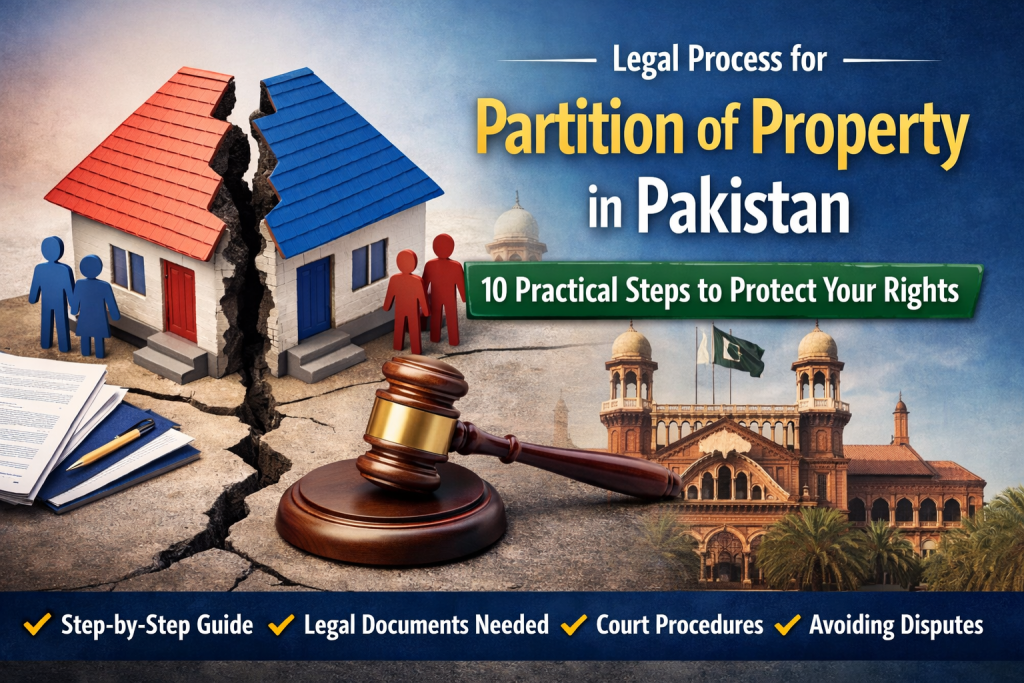
Co‑ownership of property in Pakistan—whether inherited or jointly purchased—can lead to disputes when co‑owners or heirs want to divide their shares. Without understanding the legal process for partition of property in Pakistan, disagreements can result in prolonged litigation, financial loss, and strained relationships.
Table of Contents
Knowing the correct legal steps ensures your ownership rights are protected, the property is divided fairly, and future conflicts are avoided.
Key Takeaways
-
Understand your legal rights in property partition cases.
-
Learn the step-by-step legal procedure to file a partition suit.
-
Know which documents and authorities are required.
-
Avoid common mistakes that delay or complicate the process.
-
Use official online tools to verify property records and track progress.
Detailed Problem Analysis
Property disputes in Pakistan often arise due to:
-
Informal ownership agreements – Many properties are co-owned without registered agreements.
-
Family disagreements – Heirs or partners may have conflicting interests.
-
Lack of documentation – Missing title deeds, mutation records, or proof of inheritance complicates legal proceedings.
-
Court delays – Partition suits can take years if filed incorrectly or with incomplete documents.
Example Scenario:
A father dies leaving a house to three children. Two wish to sell, one wants to retain ownership. Without proper documentation or a legal partition, the disagreement escalates to a civil court case that may take several years to resolve.
Step-by-Step Solutions / Guide
Follow these 10 actionable steps to complete property partition legally and efficiently.
1. Confirm Ownership and Shares
-
Verify all co-owners listed on the title deed.
-
Identify legal heirs if the property is inherited.
-
Obtain certified copies of title deeds and land records.
2. Attempt Amicable Settlement
-
Discuss division with all co-owners.
-
Draft a Partition Deed if everyone agrees.
-
Register the deed to avoid court proceedings.
3. Send a Legal Notice
-
Formally request partition to all co-owners.
-
Keep proof of delivery for court submission.
4. File a Partition Suit
-
File in the Civil Court where the property is located.
-
Attach necessary documents: title deeds, CNICs, legal notice, revenue records.
5. Court Proceedings & Valuation
-
Court issues notices to all parties.
-
Property valuation and preliminary evidence submission occur.
6. Court-Appointed Referee / Survey
-
Court may appoint a referee to survey and divide property physically or symbolically.
7. Physical Partition or Internal Auction
-
Property may be divided physically if possible.
-
If not, an internal auction determines ownership shares.
8. Final Court Decree
-
After reviewing objections, the court issues a partition decree.
9. Register the Decree
-
Take the decree to the land revenue office for official record updates.
10. Mutation of Property
-
Update the property mutation entries (ownership records) in local revenue offices.
Documents Required
| Document | Purpose |
|---|---|
| Title Deed / Registry | Proof of ownership |
| CNICs of Co‑owners | Identity verification |
| Legal Notice | Proof of partition request |
| Family Tree / Heirship Proof | Establishes legal entitlement |
| Revenue Records (Khasra/Girdawari) | Land details and history |
| Previous Partition Deeds | Existing agreements (if any) |
Authorities Involved & Approximate Fees
| Authority | Function | Fee |
|---|---|---|
| Civil Court | Adjudicate partition suit | Varies by province |
| Court-appointed Referee | Survey & divide property | Fixed by court |
| Land Revenue Office | Record mutation & update ownership | Minimal processing fee |
Legal & Statutory Framework
-
Punjab Partition of Immovable Property Act, 2012 – Governs partition suits in Punjab. Read here
-
Code of Civil Procedure, 1908 – Contains rules for partition suits and decrees. Official reference
-
Transfer of Property Act, 1882 – Rights and obligations of co-owners. View Act
Simple Explanation:
A partition suit allows the court to divide property among co-owners so that each person gets a legally recognized share.
Regional or Situational Variations
-
Punjab: Governed by the Partition of Immovable Property Act, 2012.
-
Sindh, KPK, Balochistan: Partition suits proceed under the Code of Civil Procedure.
-
Agricultural Land: May involve local revenue officials; rules differ from urban property.
Digital & Online Solutions / Tools
-
Punjab LMS (Land Management System) – https://lms.punjab.gov.pk
-
Sindh SSRIMS Portal – https://ssrims.sindh.gov.pk
-
KPK E‑Patwar System – https://epatwar.kp.gov.pk
Tip: Always download certified copies from these portals for court submission.
Common Challenges & How to Overcome Them
-
Incomplete Documents – Collect certified copies beforehand.
-
Family Disputes – Attempt mediation; involve a lawyer early.
-
Incorrect Court Filing – File in the jurisdiction where property exists.
-
Long Delays – Provide full documentation and respond promptly to court notices.
FAQs
-
What is a partition suit?
A civil case to divide jointly owned property among co-owners. -
Can one co-owner file without others’ consent?
Yes — any co-owner may file a partition suit. -
Do I need a lawyer?
Yes, to handle legal drafting and court procedures. -
How long does it take?
6 months to several years, depending on complexity. -
Can property be sold during the suit?
Usually not, until the court allows. -
Is there a limitation period?
Generally 12 years under the Limitation Act 1963. -
Does religion affect share calculation?
Yes, personal law (Muslim or non-Muslim) determines heir shares. -
Can mutation be done online?
Yes, via provincial land record portals.
Conclusion
The legal process for partition of property in Pakistan ensures fair and enforceable division among co-owners or heirs. Start by gathering documents, attempt amicable settlement, and if necessary, file a properly prepared partition suit. Always consult a qualified lawyer to protect your rights effectively.
Contact
📞 Call/WhatsApp: +92-333-4241182
🌐 Website: www.pakistanlegalservices.com
Comments
💬 Have you faced property issues while living abroad?
Share your experience or questions below—your input may help others protect their property.
Disclaimer
⚠️ Disclaimer: This article is for informational purposes only. It does not constitute legal advice. For personalized assistance, consult a qualified lawyer in Pakistan.
About Author
👤 Zaman Khan Vardag is an Advocate of the Supreme Court of Pakistan and the founder of Pakistan Legal Services. He provides legal representation and advisory services in civil, criminal, and property matters, focusing on assisting overseas Pakistanis and foreign nationals.