
In Pakistan, specific performance of contract in Pakistan is a cornerstone of contract law, ensuring that parties honor their agreements when monetary compensation is inadequate. Rooted in the Specific Relief Act, 1877, this legal remedy empowers courts to compel parties to fulfill contractual obligations. Whether in real estate, commercial transactions, or overseas Pakistani property disputes, understanding specific performance is crucial for both businesses and individuals. This guide explores the legal framework, statutory provisions, Islamic principles, court practices, and practical steps to enforce contracts in Pakistan.
Table of Contents
Key Takeaways
- Specific performance of contract in Pakistan is vital for enforcing contractual obligations.
- Courts use discretion to balance equities and ensure fair enforcement.
- Both statutory and Islamic principles guide enforcement.
- Real estate and business contracts are the most common scenarios.
- Procedural steps, documentation, and jurisdiction play a key role in successful filing.
Understanding Specific Performance of Contract in Pakistan
Definition and Legal Basis
Specific performance is a legal remedy where the court orders a party to perform exactly what they promised in a contract. Unlike damages, which compensate financially, specific performance compels actual execution of contractual obligations.
In Pakistan, the Contract Act, 1872, and Specific Relief Act, 1877, serve as the backbone for specific performance enforcement. Courts rely on these laws to decide whether to grant this equitable remedy.
When Specific Performance is Available
Specific performance is granted under certain conditions:
| Condition | Description |
|---|---|
| Valid Contract | Existence of a legally binding contract under Pakistani law |
| Breach of Contract | Failure of one party to perform contractual obligations |
| Monetary Inadequacy | Money alone cannot compensate for breach |
| Readiness and Willingness | Plaintiff must show they are prepared to perform their part |
Courts exercise discretion, considering fairness, feasibility, and conduct of both parties before granting specific performance.
Historical Development in Pakistan
Colonial and British Influence
Specific performance in Pakistan evolved from British legal principles during colonial rule. Pre-partition precedents shaped post-independence interpretations. The equitable remedy introduced by the British remains central in contemporary Pakistani jurisprudence.
Post-Independence Evolution
After 1947, Pakistan integrated statutory law with Islamic principles. The Specific Relief Act, 1877, and Contract Act, 1872, were adopted, while courts began referencing Quranic teachings and Hadith to guide justice in contractual disputes.
Legal Framework Governing Specific Performance
Specific Relief Act, 1877
- Section 12: Grants discretion to courts for enforcing specific performance.
- Section 22: Provides compensation when performance cannot be enforced fully.
- Recent amendments have simplified procedures, making the remedy more accessible.
Contract Act, 1872
- Sections 37–39: Outline duties of parties to perform contracts and consequences of breach.
- Works in conjunction with the Specific Relief Act to ensure enforceability.
Islamic Principles in Contract Enforcement
Islamic law greatly influences specific performance of contract in Pakistan. The Quran emphasizes keeping promises:
- Surah Al-Maidah (5:1): “Fulfill all contracts…”
- Surah Al-Baqarah (2:282): Encourages documentation and witnesses in agreements.
Sharia and Fiqh principles stress justice, fairness, and fulfillment of obligations. Pakistani courts often reference these teachings to align statutory law with Islamic ethics.
Conditions for Granting Specific Performance
- Valid and Enforceable Contract: Must comply with Contract Act, 1872, and be free of fraud, coercion, or illegality.
- Inadequacy of Monetary Compensation: Money should not sufficiently address breach; common in unique property or business agreements.
- Readiness and Willingness to Perform: Plaintiff must demonstrate preparedness to fulfill contractual obligations.
Discretionary Nature of Remedy
Courts assess:
- Conduct of both parties
- Feasibility of performance
- Public interest and fairness
Balancing equities ensures that enforcement is just, avoiding undue hardship on any party.
Contracts Where Specific Performance Cannot Be Enforced
| Type | Reason | Example |
|---|---|---|
| Personal Service Contracts | Cannot compel personal labor | Specialized consultancy |
| Continuous Duty Contracts | Ongoing obligations require court supervision | Long-term franchise agreements |
| Practical Impossibility | Physical or legal barriers | Destruction of property, change in law |
Landmark Supreme Court Decisions
Pre-2000 Cases
- Mst. Niaz Begum v. Fazal Ahmad (PLD 1963 SC 486): Reinforced importance of contract fulfillment.
Post-2000 Cases
- Abdul Ghaffar v. Muhammad Yousaf (2015 SCMR 139): Clarified scope of specific performance in commercial contracts.
These cases highlight the court’s discretion, consideration of fairness, and protection of contractual rights.
Real Estate Contracts and Specific Performance
Property Transfer Disputes
- Sale agreements often lead to disputes over payment, boundaries, or title.
- Specific performance ensures transfer as per the contract terms.
Overseas Pakistani Concerns
- Power of attorney management
- Monitoring transactions remotely
- Legal compliance in Pakistan
Documentation Requirements
| Document | Purpose | Requirement |
|---|---|---|
| Sale Agreement | Terms of sale | Mandatory |
| Property Title | Ownership proof | Mandatory |
| Registration Documents | Official record | Mandatory |
Business and Commercial Contracts
Specific performance applies to:
- Supply agreements
- Partnership contracts
- Franchise and licensing agreements
Courts evaluate feasibility, fairness, and potential impact on third parties before enforcement.
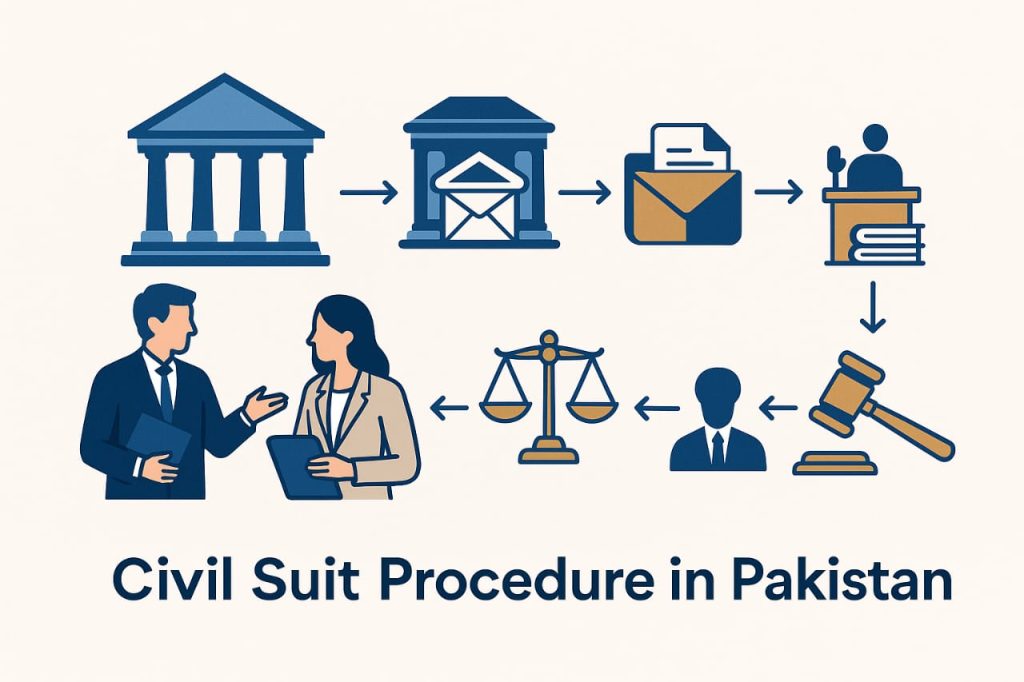
Procedure for Filing a Suit
- Identify the Public Issue: Contract breach affecting rights or business obligations.
- Gather Evidence: Contract, correspondence, proof of payment.
- Draft Writ Petition: Include facts, legal violations, relief sought.
- File in Appropriate Court: District or High Court based on jurisdiction.
- Serve Notices: Notify the other party.
- Hearing: Courts examine evidence, fairness, and conduct.
- Final Judgment: May include directions, compensation, or enforcement orders.
Jurisdiction and Limitation
- Limitation Act, 1908: Typically 3 years from breach discovery
- District and High Courts: Determine territorial jurisdiction based on contract location
Comparative Perspective
| Country | Legal Framework | Approach |
|---|---|---|
| Pakistan | Specific Relief Act, 1877 | Cautious, discretionary |
| UK | Chancery Amendment Act 1858 | Equitable remedy |
| US | Uniform Commercial Code | Frequently recognized |
| Saudi Arabia | Sharia Law | Strong emphasis on fulfillment |
Lesson for Pakistan: Harmonize common law discretion with Sharia-based enforcement for practical and fair remedies.
Practical Examples
- Real estate sale where money damages insufficient → court orders transfer of property.
- Overseas Pakistani appoints attorney → specific performance used to enforce property sale.
- Supply contract breach → courts order actual delivery of goods.
Internal & External Links (Placeholders)
- Internal: Property Law in Pakistan, Contract Drafting Tips
- External (DoFollow): Supreme Court of Pakistan, Pakistan Law Site
- External (NoFollow): Legal News Pakistan, Pakistani Bar Association
FAQs
1. What is specific performance of a contract in Pakistan?
It is a court-mandated enforcement of contractual obligations when monetary compensation is insufficient.
2. When can specific performance be enforced?
When a valid contract exists, monetary damages are inadequate, and the plaintiff is ready to perform.
3. Can personal service contracts be enforced?
No, due to impracticality and ethical concerns in compelling personal labor.
4. What is the limitation period for filing?
Generally, three years from the date of breach as per the Limitation Act, 1908.
5. How do courts balance fairness?
By evaluating conduct, feasibility, public interest, and potential hardship on both parties.
Conclusion
Understanding specific performance of contract in Pakistan is crucial for protecting business, property, and personal rights. Courts, guided by statutory law and Islamic principles, ensure that contractual promises are honored. Real estate, business agreements, and overseas property deals are primary areas where this remedy is applied. By knowing procedures, documentation, jurisdiction, and limitation periods, parties can confidently enforce contracts.
You may also be intrested to read: Breach of Contract and Its Remedies : 7 Proven Steps
Contact
Pakistan Legal Services
📞 Call/WhatsApp: +92-333-4241182
🌐 www.pakistanlegalservices.com
💬 Comments
Have questions about specific performance of contract in Pakistan? Share them in the comments — we’d love to provide legal insights and guidance.
Disclaimer
This article is for informational purposes only. It does not constitute legal advice. For personalized assistance, consult a qualified lawyer in Pakistan.