

Introduction to Power of Attorney in Pakistan
A Power of Attorney in Pakistan is one of the most commonly used legal instruments for managing property, court cases, financial affairs, and administrative matters, particularly when the person concerned is living abroad or unable to act personally. Under Pakistani law, this document authorizes one person to lawfully act on behalf of another within clearly defined limits.
Table of Contents
In practice, Powers of Attorney are extensively relied upon by Overseas Pakistanis, business owners, senior citizens, and litigants who cannot remain physically present in Pakistan. However, despite its lawful foundation, the Power of Attorney is also among the most misused legal documents in Pakistan, often resulting in property fraud, unauthorized sales, forged transactions, and prolonged litigation.
Many individuals mistakenly assume that granting a Power of Attorney transfers ownership or absolute control. This assumption is legally incorrect and dangerous. Pakistani courts strictly interpret Powers of Attorney and repeatedly emphasize that an attorney is merely a representative, not an owner, trustee, or beneficiary, unless the law and the document expressly provide otherwise.
This comprehensive guide explains how a Power of Attorney works under Pakistani law, how it should be safely drafted, attested, verified, and registered, and how courts determine its validity, scope, misuse, and cancellation. Special emphasis is placed on Power of Attorney for Overseas Pakistanis, including NADRA digital verification, embassy attestation, online execution, and property registration requirements.
The guide also highlights statutory provisions, judicial interpretation, and best legal practices to help principals protect themselves from abuse, especially in high-value property matters.
By the end of this pillar article, you will clearly understand:
- What a Power of Attorney legally is — and what it is not
- Which type of Power of Attorney is safest for your situation
- How NADRA Digital and Online Power of Attorney works
- When registration is legally mandatory
- How misuse occurs and how to prevent it
What Is a Power of Attorney (Mukhtar Nama) in Pakistan
A Power of Attorney in Pakistan, commonly referred to as “Mukhtar Nama”, is a legal instrument through which one person (the Principal) authorizes another person (the Attorney or Mukhtar) to act on their behalf for specific legal, financial, property, or administrative purposes.
Under Pakistani law, a Power of Attorney does not transfer ownership, title, or proprietary rights. It merely creates a relationship of agency, where the attorney acts as a lawful representative within the exact authority granted in writing.
Legal Definition and Nature
In legal terms, a Power of Attorney is an authorization document, not a conveyance. The attorney:
- Acts in the name and stead of the principal
- Is bound strictly by the written terms of authority
- Cannot assume implied, verbal, or moral authority beyond the document
Pakistani courts consistently hold that:
- Authority must be express, not assumed
- Intent or family relationship is irrelevant without written authorization
- Any act beyond the granted authority is void and challengeable
Key Legal Characteristics of a Power of Attorney in Pakistan
A valid Power of Attorney in Pakistan has the following core characteristics:
- Representative Capacity Only
The attorney represents the principal; they do not replace them legally or acquire independent rights. - No Transfer of Ownership
A Power of Attorney does not create title, ownership, or beneficial interest in property or assets. - Limited by Written Scope
The attorney can only perform acts explicitly mentioned in the document. - Revocable Authority
Unless legally restricted, a PoA can be revoked at any time by the principal. - Terminates Automatically
A Power of Attorney generally ends upon:- Death of the principal
- Completion of the specified purpose
- Lawful revocation
Common Misconception Clarified
A widespread misunderstanding in Pakistan is that granting a Power of Attorney—especially a General Power of Attorney—gives the attorney absolute control or ownership.
This belief is legally incorrect.
Courts repeatedly emphasize that:
- Trust has no legal value without written authority
- Broad wording does not override statutory limits
- Property transactions without explicit authority are invalid
This misconception is the primary cause of Power of Attorney misuse and litigation, particularly affecting Overseas Pakistanis.
Practical Purpose of a Power of Attorney
A Power of Attorney is used when the principal:
- Resides abroad or in another city
- Is unable to attend personally due to health, employment, or travel constraints
- Needs continuous representation in Pakistan
Common practical uses include:
- Managing or selling property
- Court representation
- Banking and financial matters
- Business operations
- Educational or administrative tasks
- Immigration and documentation matters
Legal Importance of Proper Understanding
Understanding the true legal nature of a Power of Attorney in Pakistan is critical because:
- Courts do not protect careless principals
- Abuse claims succeed only when legal boundaries are crossed
- Poor drafting leads directly to fraud and loss
This is why courts examine:
- The exact language of the PoA
- Whether authority was clearly defined
- Whether legal procedures like registration and verification were followed
Law Governing Power of Attorney in Pakistan
The legal framework governing a Power of Attorney in Pakistan is well-established and strictly interpreted by courts. Pakistani courts do not rely on personal relationships, intentions, or trust; instead, they enforce statutory law and the written text of the Power of Attorney.
A Power of Attorney is treated as a form of agency, and its validity, scope, and enforceability depend entirely on compliance with the relevant laws.
Primary Laws Governing Power of Attorney in Pakistan
1. Powers of Attorney Act, 1882
The Powers of Attorney Act, 1882 is the principal statute governing Powers of Attorney in Pakistan. It recognizes the legal validity of powers granted by a principal and protects acts lawfully done by an attorney within the granted authority.
Key legal principles under this Act:
- Authority must be lawfully executed
- Acts done within authority are binding on the principal
- Courts interpret authority strictly, not liberally
This Act does not create ownership rights and does not override other mandatory laws such as registration requirements.
2. Contract Act, 1872 (Law of Agency)
A Power of Attorney operates under the law of agency as defined in the Contract Act, 1872.
Relevant principles include:
- The attorney is an agent, not a transferee
- The principal retains ultimate ownership and control
- The principal has the right to revoke authority, subject to legal limits
- Acts done beyond authority are unauthorized and void
Courts rely heavily on agency principles to decide disputes involving misuse, excess authority, or fraudulent acts.
3. Registration Act, 1908 (Section 17)
The Registration Act, 1908 plays a decisive role in property-related Powers of Attorney.
Under Section 17, registration is mandatory for:
- Power of Attorney authorizing sale, transfer, gift, lease, or mutation of immovable property
- Documents used to affect rights in immovable property
An unregistered Power of Attorney involving property:
- Is inadmissible in evidence
- Cannot be relied upon for mutation
- Is frequently rejected by courts and revenue authorities
This provision is particularly critical for Overseas Pakistanis, whose unregistered or improperly registered documents often become the basis of litigation.
4. NADRA Laws and Regulations (For Overseas Pakistanis)
For principals residing abroad, NADRA regulations play a central role in identity verification.
NADRA requirements include:
- Biometric verification of the principal
- CNIC / NICOP / POC validation
- Digital linkage with embassy or consular attestation
Courts increasingly rely on NADRA verification to:
- Detect forged Powers of Attorney
- Confirm the identity and consent of overseas principals
- Invalidate unverified or manipulated documents
5. Provincial Land Revenue Laws
Each province applies its own land and revenue laws for:
- Mutation
- Transfer entries
- Record updates
Revenue authorities generally refuse to process property matters unless:
- The Power of Attorney is properly registered
- Identity verification is complete
- The authority to deal with property is explicit
How Courts Apply These Laws
Pakistani courts apply the law with strict textual interpretation, meaning:
- No implied authority is recognized
- Family relationships carry no legal weight
- Equity does not override statutory requirements
Courts examine:
- Whether the Power of Attorney complies with all relevant statutes
- Whether authority was properly granted and exercised
- Whether procedural safeguards (registration, verification) were followed
Failure to comply with any one governing law can render a Power of Attorney ineffective or unenforceable.
Legal Insight (Expert Note)
Most Power of Attorney disputes in Pakistan are lost not because the principal was wrong, but because:
- The document violated a statutory requirement
- Registration was skipped
- Authority was drafted vaguely
- Verification was incomplete
Understanding the laws governing Power of Attorney in Pakistan is therefore not optional—it is the foundation of enforceability and protection.
Types of Power of Attorney in Pakistan
Understanding the types of Power of Attorney in Pakistan is critical because choosing the wrong type is the single biggest cause of misuse, fraud, and litigation. Pakistani courts assess not what the parties intended, but what type of authority was legally granted in writing.
A Power of Attorney may be categorized based on scope, purpose, duration, and control mechanisms.
1. General Power of Attorney (GPA)
A General Power of Attorney grants broad and wide-ranging authority to the attorney to act on behalf of the principal in multiple matters.
Typical Powers Granted
- Managing movable and immovable property
- Handling bank accounts and financial affairs
- Appearing before courts or government departments
- Entering into contracts
- Representing the principal generally
Legal Risk Assessment
- ⚠️ Highest risk of abuse
- Often used incorrectly for property transactions
- Frequently challenged in courts when misused
Pakistani courts strictly examine GPAs and often invalidate actions where:
- Authority is vague or overbroad
- Self-dealing occurs
- Property powers are not explicitly registered
Professional Recommendation
General Power of Attorney should be avoided for property matters, especially by Overseas Pakistanis.
2. Special Power of Attorney (SPA)
A Special Power of Attorney grants authority only for a specific task or transaction, such as selling a particular property or appearing in a particular case.
Typical Uses
- Sale or purchase of a specific property
- Filing or defending a court case
- One-time banking or documentation task
- Representation before a specific authority
Legal Advantages
- ✅ Limited scope reduces misuse
- ✅ Clear authority simplifies court scrutiny
- ✅ Preferred by courts and revenue authorities
Professional Recommendation
Special Power of Attorney is the safest and most legally secure option, particularly for Overseas Pakistanis and property transactions.
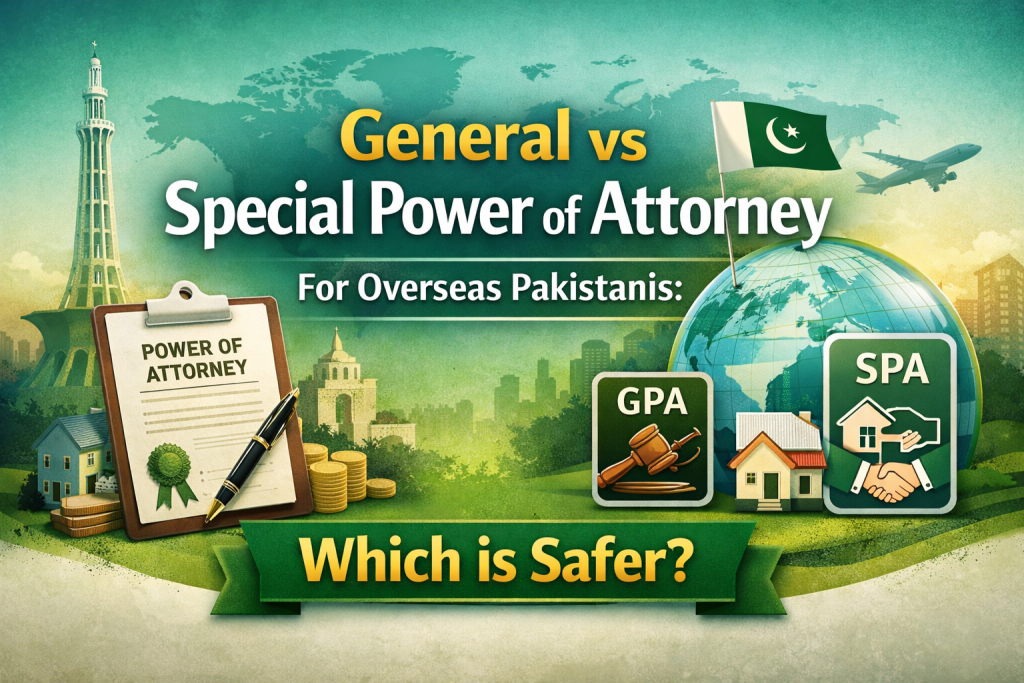
General Power of Attorney Vs Special Power of Attorney
3. Joint Power of Attorney
A Joint Power of Attorney appoints two or more attorneys, who must act jointly or as specified in the document.
When It Is Advisable
- High-value property transactions
- Family property management
- Situations requiring mutual oversight
Advantages
- Reduced risk of unilateral fraud
- Built-in accountability
Limitations
- Potential delays due to coordination issues
- Requires careful drafting to avoid deadlock
4. Durable Power of Attorney
A Durable Power of Attorney remains effective even if the principal becomes mentally or physically incapacitated.
Legal Status in Pakistan
- Recognized under agency principles
- Must be clearly stated in writing
- Automatically terminates upon death
Use Cases
- Elderly principals
- Long-term medical conditions
5. Property-Specific Power of Attorney (Mukhtar Nama)
A Property Power of Attorney (Mukhtar Nama) is drafted exclusively for immovable property matters.
Key Legal Requirements
- Precise property description
- Explicit sale/transfer authority
- Mandatory registration under the Registration Act
- NADRA verification for overseas principals
Unregistered or vague property PoAs are frequently rejected by:
- Courts
- Land registries
- Revenue authorities
Choosing the Right Type: Legal Insight
Courts repeatedly observe that:
- Fraud arises from overly broad authority
- Safety lies in precision, limitation, and registration
- The “wrong type” of PoA invalidates otherwise lawful transactions
Uses of Power of Attorney in Pakistan
A Power of Attorney in Pakistan is not merely a procedural document; it is a functional legal instrument used to lawfully manage affairs when the principal cannot act personally. Understanding its legitimate uses helps distinguish lawful delegation from dangerous overreach, especially for Overseas Pakistanis.
Pakistani courts evaluate a POA based on purpose-specific usage, not convenience.
1. Property Transactions (Most Common Use)
Lawful Uses
- Sale of a specific immovable property
- Purchase of property on behalf of principal
- Signing sale agreements, registry, mutation documents
- Appearance before Sub-Registrar / Land Authorities
Legal Caution
Courts have consistently held that:
- A POA does not transfer ownership
- Sale authority must be explicit and registered
- GPA-based property sales are closely scrutinized
Best Practice: Always use a Special Power of Attorney for property matters.
2. Representation Before Courts & Tribunals
Permissible Uses
- Filing suits, appeals, or applications
- Engaging advocates
- Giving statements limited to procedural matters
Legal Limitation
A litigation POA:
- Does not authorize financial or property dealings
- Must clearly restrict authority to court proceedings only
This type carries minimal misuse risk when properly drafted.
3. Banking & Financial Matters
Common Uses
- Operating bank accounts
- Collecting income, rent, or dividends
- Signing cheques or documents
- Dealing with FBR or tax authorities
High-Risk Area
Financial POAs are among the most abused, particularly when:
- Authority is unlimited
- No reporting obligation exists
- Overseas principals cannot monitor transactions
Professional Advice: Banking powers must be transaction-specific and capped.
4. Business & Commercial Representation
Legitimate Uses
- Managing business operations
- Signing contracts
- Dealing with suppliers or authorities
- Representing companies before regulators
Legal Risk
Unrestricted business POAs may:
- Bind principals to liabilities
- Create tax exposure
- Enable unauthorized contracts
Clear scope, duration, and financial ceilings are essential.
5. Government & Administrative Matters
Uses Include
- NADRA documentation
- Passport or immigration follow-ups
- Utility connections
- Revenue or municipal matters
These are generally low-risk, provided authority is clearly limited.
6. Overseas Pakistanis’ Practical Use Cases
Overseas Pakistanis commonly use POAs for:
- Property management
- Rent collection
- Litigation handling
- Tax compliance
- Asset protection
However, courts acknowledge that:
Physical absence increases vulnerability, requiring stricter drafting standards.
Misuse Arises When Purpose Is Unclear
Courts often invalidate POA actions where:
- Purpose is vague
- Powers exceed stated use
- Attorney acts beyond necessity
Use determines legality.
A lawful POA becomes dangerous when used outside its intended function.
✔ Key Legal Takeaways
- A POA must be purpose-driven
- Each use requires specific authorization
- Property and financial uses carry the highest risk
- Overseas Pakistanis must prefer limited, task-based POAs
Misuse of Power of Attorney in Pakistan
While a Power of Attorney (POA) is legally powerful, it is also one of the most frequently abused documents in Pakistan, particularly by Overseas Pakistanis. Misuse often results in unauthorized property sales, financial loss, family disputes, and litigation.
Understanding the common patterns of abuse is critical to preventing fraud and safeguarding your legal and financial interests.
Abuse of Power of Attorney in Pakistan Alerts for Overseas Pakistanis
1. Common Forms of POA Misuse
a) Authority Inflation
- Attorneys act beyond the powers granted.
- Example: A Special POA given for selling one property is used to sell multiple properties.
- Root Cause: Vague drafting or lack of monitoring.
b) Silent Expansion of Powers
- Unauthorized acts performed without informing the principal.
- Overseas Pakistanis face delays in detecting abuse due to time zones and communication gaps.
c) Procedural Exploitation
- Acting after revocation, expiry, or death of the principal.
- Misrepresentation may be made to authorities or third parties to legitimize actions.
d) Exploitation of Vague Clauses
- Terms like “full powers” or “all matters” allow attorneys to justify acts not intended by the principal.
e) Fraudulent Documentation
- Forged or altered POA documents (fake signatures, false witness details).
- Submitted to banks, registrars, or authorities to commit unauthorized transactions.
f) Proxy & Third-Party Abuse
- Attorneys delegate authority to unapproved third parties, increasing risk and complicating accountability.
2. Property-Specific Abuse
Property is the highest-risk area for POA misuse:
- Illegal Sale Deeds: Sale without consent or beyond granted authority.
- Benami Transactions: Property sold in another person’s name to hide real ownership.
- Undervaluation & Fake Consideration: Property sold below market price; consideration falsified.
- Mutation & Registry Manipulation: Unauthorized updates in land records.
- Use of Unregistered/Invalid POA: Attempted transactions with unregistered POAs, temporarily enabling unauthorized acts.
- Collusion with Brokers/Agents: Creates layers of deniability and legal complexity.
Legal Note: Courts often nullify illegal mutations and property sales, but recovery is time-consuming and expensive.
3. Financial & Banking-Related Abuse
Overseas Pakistanis frequently grant POAs for banking purposes. Common abuses include:
- Unauthorized Withdrawals: Cheques, transfers, recurring withdrawals.
- Misuse of Business Accounts: Diverting funds, unauthorized contracts, falsifying statements.
- Rent or Income Misappropriation: Withholding or misreporting income.
- Tax Exposure Creation: Unauthorized financial acts causing penalties.
- Bank Documentation Exploitation: Forged signatures, fake mandates, or misrepresentation to banks.
Preventive Measures:
- Limit POA to specific accounts or transactions.
- Request periodic statements or reports.
- Use joint notifications for high-value accounts.
- Regular audits or monitoring by a trusted lawyer or agent.
4. Who Is Likely to Abuse a POA
- Blood Relatives: Siblings, children, extended family.
- Spouses & In-Laws: Manipulation for personal gain or inheritance advantage.
- Friends & Close Associates: Acting outside authority, especially with dual control over property and finance.
- Lawyers / Agents: Acting beyond mandate or colluding with third parties.
Red Flags:
- Unilateral decisions
- Refusal to provide documentation
- Frequent unexpected transactions
- Lack of transparency
Key Takeaway: Misuse often comes from trusted individuals, not strangers. Overseas Pakistanis are particularly vulnerable due to physical absence.
5. Legal Consequences of POA Misuse
Civil Remedies
- Cancellation / Revocation: Courts nullify POA if authority is exceeded.
- Restitution / Recovery: Recover misappropriated property or funds.
- Injunctions / Interim Orders: Freeze ongoing unauthorized transactions.
- Declaratory Relief: Declare unauthorized acts void.
Criminal Liability
- Breach of Trust: Sections 406–409 PPC
- Cheating / Fraud: Sections 417–420 PPC
- Forgery: Sections 463–471 PPC
Parallel Proceedings: Civil and criminal cases may run simultaneously, requiring local legal representation.
Evidentiary Challenges:
Courts require bank records, property mutation documents, and witness statements. Vague or unregistered POAs weaken the principal’s case.
6. Key Takeaways for Prevention
- Clearly define scope, duration, and limits in the POA.
- Monitor activity through trusted local representatives.
- Use Special POA for property and financial matters.
- Ensure registration, NADRA verification, and attestation.
- Early detection and documentation prevent irreversible losses.
Legal Safeguards & Precautions for Power of Attorney in Pakistan
To protect yourself and your assets, especially as an Overseas Pakistani, it is critical to implement legal safeguards when drafting, executing, and using a Power of Attorney (POA). These measures reduce the risk of misuse, fraud, and costly litigation.
1. Use the Correct Type of POA
- Special / Limited POA: Recommended for property sales, banking, or business transactions. Clearly defines authority.
- General POA: Avoid unless absolutely necessary; high risk of abuse.
- Litigation-Only POA: Best for legal representation without financial or property powers.
- Durable POA: Only use if incapacity protection is needed; ensure clear limits.
Professional Recommendation: For 90% of property and overseas transactions, use a Special Power of Attorney.
2. Draft Clearly & Legally
- Specify exact purpose and scope.
- Include prohibited actions explicitly.
- Avoid vague terms like “full powers” or “all matters.”
- Insert revocation clause.
- Define time limits for execution.
- Include mandatory reporting duties.
Tip: Poor drafting is the leading cause of POA disputes.
How to Draft a Secure Power of Attorney in Pakistan
3. Proper Identification & Witnesses
- Include full CNIC/NICOP, passport, address, and contact details of principal and attorney.
- Use two independent witnesses (Pakistani nationals, 18+) who are not beneficiaries.
- Thumb impressions recommended where signatures are disputed.
This strengthens evidentiary credibility in case of litigation.
4. Attestation & Registration
Domestic Execution
- CNIC verification of all parties.
- Registration at Sub-Registrar mandatory for property-related POAs.
- Payment of stamp duty ensures legal validity.
Overseas Execution
- Execution at Pakistani Embassy or Consulate.
- Embassy attestation or consular verification required.
- Original PoA couriered securely to Pakistan.
- Registration at Sub-Registrar for property matters.
Key Insight: Unregistered, unstamped, or unverified POAs are vulnerable to legal challenge.
5. Use Institutional Safeguards
- NADRA Verification: Biometric authentication for principal, attorney, and witnesses.
- Land Record Portals: Track mutations and registry updates in Punjab, Sindh, KPK.
- Banking Controls: Limit accounts, periodic reporting, and joint notifications for high-value transactions.
Proactive Monitoring is as important as proper drafting.
6. Limit Authority & Include Protective Clauses
- Time-bound validity (e.g., 30–60 days).
- One-transaction rule for property or financial matters.
- Mandatory reporting via email, WhatsApp, or lawyer updates.
- Absolute ban on sub-delegation.
- Penalties for unauthorized actions.
A PoA without protective clauses is legally and financially risky.
7. Revocation & Post-Execution Precautions
- Maintain copies in Pakistan and abroad.
- Notify attorney and relevant authorities immediately if revoking.
- Publish revocation in a local newspaper (optional but strengthens evidence).
- Confirm revocation in NADRA and Sub-Registrar records.
- Monitor property, bank, and business transactions until the revocation is effective.
8. Special Precautions for Overseas Pakistanis
- Prefer Special POA over General POA.
- Avoid granting authority for cash handling or multiple properties.
- Use banking channels only for financial transactions.
- Appoint a trusted local lawyer or representative for oversight.
- Fix regular reporting intervals and include penalties for non-compliance.
✔ Key Takeaways
- Correct type + clear drafting + registration + monitoring = secure POA.
- Use institutional tools (NADRA, land portals, banking controls) to prevent abuse.
- Overseas Pakistanis must implement multi-layered safeguards to protect assets.
Verification, Revocation & Judicial Recognition of Power of Attorney in Pakistan
Understanding verification, revocation, and judicial recognition is crucial to ensure that a Power of Attorney (POA) is legally enforceable and protected from misuse, especially for Overseas Pakistanis.
1. Verification of Power of Attorney
Verification ensures authenticity and prevents fraudulent use.
a) NADRA Verification
- CNIC/NICOP verification for principal, attorney, and witnesses.
- Biometric confirmation links POA to official records.
- Online verification portal available for property and banking-related POAs.
b) Consular / Embassy Verification (Overseas)
- Execution at Pakistani Embassy or Consulate.
- Attestation confirms authenticity for use in Pakistan.
- Original documents should be securely sent to Pakistan.
c) Document Checks
- Ensure registration for property matters.
- Check stamp duty compliance.
- Confirm witness authenticity.
Professional Tip: Unverified POAs are frequently invalidated in courts, even if properly drafted.
2. Revocation of Power of Attorney
Revocation terminates the attorney’s authority and prevents further misuse.
a) Methods of Revocation
- Registered Deed of Revocation: Officially filed at Sub-Registrar for property matters.
- Written Notice: Notify attorney and relevant authorities (banks, land offices).
- Newspaper Publication: Provides public evidence of revocation.
- Automatic Termination: Upon death of principal or completion of purpose (if clearly stated).
b) Special Considerations for Overseas Pakistanis
- Send attested notices via embassy or courier.
- Confirm revocation in NADRA records.
- Notify banks, registrars, and local lawyers promptly.
Delayed revocation increases risk of continued unauthorized acts.
3. Judicial Recognition & Enforcement
Courts in Pakistan recognize POAs based on authenticity, registration, scope, and compliance.
a) Courts’ Approach
- Strictly adhere to the written authority.
- Actions beyond granted powers are voidable or illegal.
- Special POAs are preferred over General POAs in disputes.
b) Key Judicial Precedents
- 2017 SCMR 447: Attorneys cannot sell property without explicit authority.
- PLD 2002 SC 615: POA does not transfer ownership rights.
- PLD 2018 SC 695: Forged or unverified POAs create no legal rights.
c) Evidence Requirements
- Original document vs. photocopy.
- Proper registration and attestation.
- Witness testimony confirming execution.
- Scope of authority clearly defined.
Courts protect principals, especially overseas absent parties, when evidence and procedural compliance are demonstrated.
4. Practical Steps for Principals
- Always verify POA authenticity before allowing attorney to act.
- Maintain updated copies in Pakistan and abroad.
- Confirm revocation is recorded in relevant authorities.
- Monitor property, banking, and business transactions actively.
✔ Key Takeaways
- Verification prevents fraudulent use; revocation stops unauthorized actions.
- Courts enforce POAs strictly according to written authority, registration, and attestation.
- Overseas Pakistanis must combine legal drafting, verification, and judicial awareness for maximum protection.
Common Mistakes, Red Flags & Expert Recommendations for Power of Attorney in Pakistan
Even legally valid POAs can become risky if drafting, execution, or monitoring mistakes occur. Understanding common pitfalls, warning signs, and expert precautions helps principals, especially Overseas Pakistanis, safeguard property, finances, and legal rights.
1. Common Mistakes People Make
a) Vague or Overbroad Authority
- Using terms like “full powers” or “all matters.”
- Grants unintended authority, leading to abuse.
b) Ignoring Registration or Stamp Requirements
- Property-related POAs must be registered under Section 17, Registration Act, 1908.
- Missing registration or stamp duty can render the document challengable in court.
c) Skipping Verification
- Overseas Pakistanis some times rely only on drafted POAs without NADRA or consular verification.
- Unverified POAs are prone to legal disputes.
d) Blind Trust in Family or Friends
- Delegating broad powers without monitoring.
- Risk increases when principal is abroad.
e) Lack of Revocation Procedure
- No revocation clause or unclear process.
- Can result in attorney acting after intended authority ends.
2. Red Flags to Monitor
a) Unilateral Decisions
- Attorney making property, banking, or business decisions without consulting the principal.
b) Refusal to Provide Documentation
- Lack of transparency regarding executed agreements or funds.
c) Frequent Unauthorized Transactions
- Sudden sales, transfers, or withdrawals beyond the granted authority.
d) Communication Delays
- Deliberate delays in reporting to principal, especially from overseas.
e) Third-Party Collusion
- Attorney acting with brokers, agents, or family members without consent.
Tip: Early detection of these red flags can prevent financial loss and legal disputes.
3. Expert Legal Recommendations
a) Drafting Safeguards
- Use Special POA for property or banking transactions.
- Clearly define scope, limitations, and duration.
- Include revocation and reporting clauses.
b) Execution & Attestation
- Obtain embassy or consular attestation for overseas execution.
- Ensure witnesses are independent and not beneficiaries.
c) Registration & Compliance
- Register property-related POAs with Sub-Registrar.
- Pay stamp duty and maintain receipts.
d) Monitoring & Oversight
- Appoint a trusted local lawyer or representative.
- Request periodic updates and transaction reports.
- Use bank and land record portals to verify activity.
e) Limiting Risk
- Avoid General POA unless necessary.
- Prohibit cash handling or sub-delegation.
- Fix time limits and ensure accountability.
✔ Key Takeaways
- Most POA disputes arise from vague authority, poor monitoring, and procedural lapses.
- Implementing drafting, attestation, registration, and oversight safeguards significantly reduces risk.
- Awareness of red flags and early warning signs empowers principals to act proactively.
- Expert legal supervision is critical for overseas property holders and high-value transactions.
Frequently Asked Questions (FAQs) on Power of Attorney in Pakistan
This FAQ section addresses the most common concerns of Overseas Pakistanis, property owners, and individuals drafting POAs in Pakistan. It provides concise, legally grounded answers for quick reference.
1. What is a Power of Attorney in Pakistan?
A Power of Attorney (POA) is a legal document through which a principal authorizes an attorney to act on their behalf for specific legal, financial, or property matters. It does not transfer ownership, only authority.
2. What are the types of Power of Attorney?
- General POA: Grants broad authority over multiple matters; higher risk of misuse.
- Special POA: Grants authority for a specific transaction; safest for overseas Pakistanis.
- Durable POA: Remains valid even if the principal becomes incapacitated.
- Litigation-only POA: Used solely for legal representation in courts.
3. Is registration mandatory for property-related POAs?
Yes. Under Section 17, Registration Act 1908, POAs involving property sales, transfers, or leases must be registered at the Sub-Registrar. Unregistered POAs may be challenged in court.
4. How can overseas Pakistanis execute a valid POA?
- Draft POA in Pakistan with legal assistance.
- Execute it at Pakistani Embassy/Consulate with attestation.
- Send original POA to Pakistan securely.
- Register at Sub-Registrar (for property matters).
- Verify via NADRA online portal.
5. Can an attorney sell property without written permission?
No. Courts have repeatedly held that unauthorized sales are invalid. A POA must explicitly authorize property transactions.
6. Does a POA transfer ownership of property?
No. POA only grants authority to act, not ownership rights. Ownership remains with the principal unless a valid transfer document is executed.
7. Can a POA be revoked?
Yes. Revocation can occur through:
- Registered deed of revocation
- Written notice to attorney and authorities
- Newspaper publication (for public notice)
- Automatic termination upon death or completion of purpose
Tip: Overseas principals must notify authorities and confirm revocation through official channels.
8. What are the risks of a General POA?
- Broad authority can be misused for unauthorized property or financial transactions.
- Courts are cautious and may nullify overbroad acts.
- Recommended only when trust and oversight mechanisms are strong.
9. What safeguards protect overseas Pakistanis?
- Prefer Special POA for property or banking matters.
- Include scope, time limits, and reporting obligations.
- Ensure embassy attestation, registration, and NADRA verification.
- Appoint a trusted local lawyer or agent for oversight.
10. What are the consequences of POA misuse?
- Civil remedies: Cancellation, restitution, injunctions, declaratory relief.
- Criminal liability: Breach of trust, cheating, forgery under Pakistan Penal Code Sections 406–471.
- Courts require proof, registration, and proper documentation for enforcement.
✔ Key Takeaways
- POA is a powerful legal tool, not ownership.
- Proper drafting, registration, verification, and monitoring prevent misuse.
- Overseas Pakistanis face unique risks, making safeguards and professional guidance essential.
- Early detection of red flags and awareness of legal remedies ensures asset protection and legal compliance.
Conclusion & Expert Recommendations on Power of Attorney in Pakistan
A Power of Attorney (POA) in Pakistan is a vital legal instrument that allows principals—especially overseas Pakistanis—to manage property, financial, or legal matters remotely. When drafted, executed, and monitored correctly, it provides convenience, control, and legal protection. However, if mismanaged, it can lead to fraud, unauthorized transfers, and lengthy litigation.
1. Key Takeaways
- POA is Authority, Not Ownership: It empowers the attorney to act but does not transfer property or title.
- Proper Drafting is Critical: Clear scope, limitations, revocation clauses, and reporting obligations reduce risk.
- Registration and Attestation Ensure Validity: Property-related POAs must be registered, and overseas POAs should have embassy/consular attestation.
- Monitoring Prevents Misuse: Regular reporting, local legal oversight, and NADRA verification are essential safeguards.
- Special POA is Safer for Overseas Pakistanis: Limits authority to a specific purpose, minimizing fraud risk.
- Legal Remedies Exist: Courts support principals with civil and criminal recourse if misuse occurs.
2. Expert Legal Recommendations
- Choose the Right Type of POA: Prefer Special or Litigation-only POA for most overseas property and legal matters. Avoid General POA unless necessary and closely monitored.
- Ensure Clear Scope and Limits: Draft with specificity—no vague authority or ambiguous phrases.
- Register Property POAs: Follow Section 17, Registration Act 1908 and pay applicable stamp duty.
- Verify Parties via NADRA: Confirm identities of principal, attorney, and witnesses, especially for overseas execution.
- Include Revocation and Reporting Clauses: Protect yourself against unauthorized acts and provide a legal basis for monitoring.
- Leverage Institutional Safeguards: Use land record portals, bank alerts, and biometric verification where available.
- Engage Legal Professionals: Professional guidance ensures enforceable, safe, and fraud-resistant POAs.
Pro Tip: For overseas Pakistanis, a securely drafted and registered Special Power of Attorney often serves as the most effective tool to manage assets, protect investments, and prevent disputes.
3. Final Word
A secure Power of Attorney in Pakistan is more than a document—it is a strategic shield protecting your property, financial assets, and legal rights. By combining careful drafting, statutory compliance, technological safeguards, and expert oversight, principals can confidently manage transactions from abroad while minimizing the risk of fraud or misuse.
Remember: The difference between a safe POA and a risky one lies in the drafting details, registration, monitoring, and execution discipline.
Contact
Pakistan Legal Services
📞 Call/WhatsApp: +92-333-4241182
🌐 www.pakistanlegalservices.com
Comments
We invite your questions and discussion. Please leave your comments below to share your thoughts or seek clarification.
Disclaimer
his article is for informational purposes only. It does not constitute legal advice. For personalized assistance, consult a qualified lawyer in Pakistan.

We have obtained a Power of Attorney (POA) in my name from all brothers and sisters residing in the USA, including myself. I intend to travel to Pakistan in the near future to finalize a real-estate transaction. The POA has been duly attested by the Consular Section of the Pakistani Embassy in Washington, D.C.
My questions are as follows:
1. Is my personal presence in Pakistan required for verification of the POA by the Ministry of Foreign Affairs (MOFA) in Karachi?
2. Is my personal presence mandatory for registration of the POA before the Registrar or Sub-Registrar Office in Pakistan?
Please note that we have also executed a limited Power of Attorney in favor of our cousin, authorizing him to complete all necessary formalities with government offices prior to my arrival in Pakistan for closing the transaction.
The relevant portion of the POA states:
“MUHAMMAD **** S/O MUHAMMAD ****, holding CNIC No. XXXXX-XXXXXXX-X, Muslim, adult, resident of Flat No. **, *** Nazimabad, Karachi, is appointed as our Special Attorney to act for us and on our behalf in respect of a PREMISES NO. (Property Address), including to cause mutation/devolution by way of inheritance in favor of the above-named executants, to record statements where required, and to carry out all necessary proceedings before the Mukhtiarkar, Assistant Commissioner, Deputy Commissioner, District South Karachi, and all other relevant offices, departments, authorities, and agencies.
He is further authorized to sign, execute, swear, affirm, verify, and submit applications, statements, declarations, affidavits, indemnity bonds, undertakings, and other required documents, and to apply for and obtain NOC for sale on behalf of the executants.
Thank you for your question. Simply, if the Power of Attorney is already attested by the Pakistani Embassy or Consulate abroad, you do not need to visit Pakistan for MOFA attestation. Any authorized person can submit the document.
You also do not need to be present to register the Power of Attorney with the Registrar or Sub-Registrar. The attorney named in the POA can handle this process.
A limited Power of Attorney holder in Pakistan can manage inheritance mutation, affidavits, NOCs, and other government office work on your behalf.
However, for the final sale deed, the owner usually must be present in Pakistan, unless a separate and clear sale Power of Attorney has been issued.
Procedures may vary slightly by office, so case-specific advice is recommended.
Assalaam O Aliakum,
I am worried that my digital POA might be misused. I need assistance in drafting and supporting me in case it is misused and I did not get required funds abroad.
Thank you for your question. However, the details of your question are not fully clear. Please clarify exactly what type of digital Power of Attorney you issued, to whom it was given, and what specific misuse you are concerned about. Once I have this information, I will be able to guide you properly and assist you with the correct legal steps.