Introduction
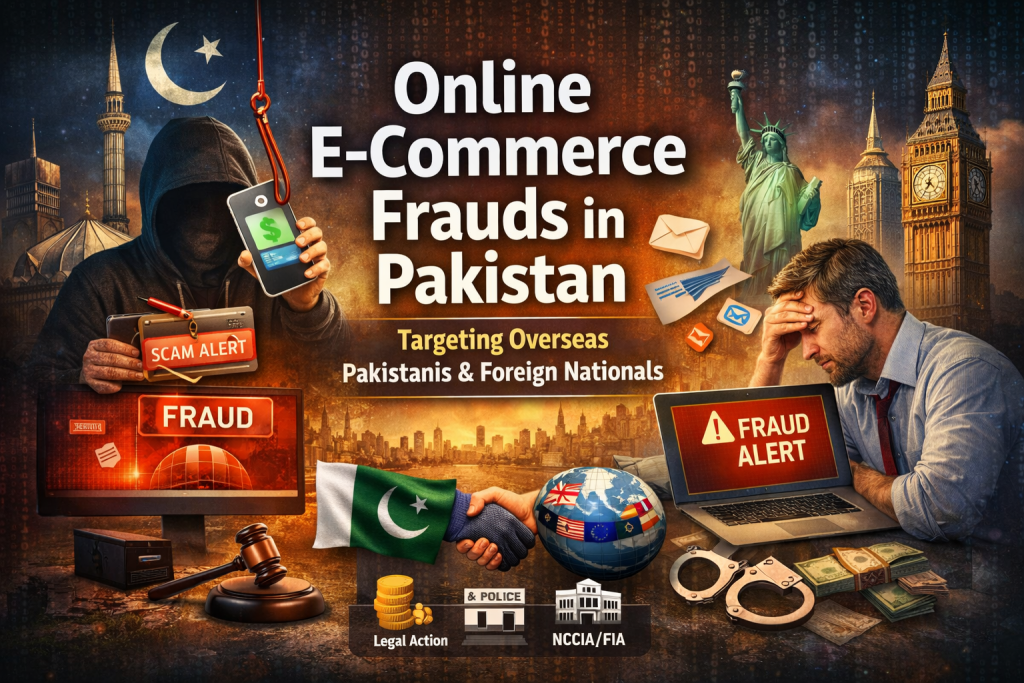
With the rapid growth of online marketplaces and freelancing platforms such as Fiverr, Upwork, and Freelancer.com, overseas Pakistanis and foreign nationals are increasingly engaging Pakistani freelancers for projects and services. However, this convenience has also given rise to E-Commerce Frauds Perpetuating in Pakistan, where unsuspecting clients are scammed through fake profiles, non-delivery of services, or unauthorized fund transfers.
Table of Contents
Such frauds not only cause financial losses but also create confusion regarding legal recourse, especially when the victim is located abroad. Overseas clients may not be familiar with Pakistan’s cybercrime laws or the complaint process, making it essential to understand how to protect oneself and seek justice.
In this blog, we explore the common types of online e-commerce and freelancing frauds targeting overseas Pakistanis and foreign nationals, present real anonymized case examples, and provide a step-by-step guide to legal remedies under Pakistan’s PECA 2016 and Pakistan Penal Code, including the role of NCCIA / FIA.
By reading this guide, overseas clients can better identify potential frauds, preserve evidence, and take legal action effectively against scammers operating in Pakistan.
What Are Online E-Commerce & Freelancing Frauds?
Definition
E-commerce and freelancing frauds are illegal acts where scammers deceive clients to gain financial benefits, usually through digital means. Examples include:
- Fake payment requests
- Non-delivery of services
- Phishing and account hijacking
- Unauthorized fund transfers
How Freelancing Scams Target Overseas Pakistanis & Foreign Nationals
- Creation of fake freelancer profiles or portfolios to appear credible
- Requesting payments outside official platform channels like PayPal, bank transfer, or cryptocurrency
- Disputes after upfront payments, including refusal to deliver or providing substandard work
- Phishing and identity theft to gain access to client accounts or sensitive information
Common Scams Targeting Overseas Pakistanis & Foreign Nationals
Freelancing and e-commerce platforms are increasingly targeted by scammers in Pakistan. Overseas clients are often vulnerable due to distance, unfamiliarity with local laws, and reliance on digital communication. Common scams include:
Non-Delivery or Fake Services
- Payment is received but agreed-upon work is not delivered
- High-quality service promises are false or exaggerated
Payment Fraud Outside Official Platforms
- Scammers request off-platform payments via bank transfer, PayPal, or cryptocurrency
- Once funds are transferred, clients lose control and recourse
Identity Theft & Phishing
- Stealing login credentials or personal information
- Unauthorized access to accounts or misuse of funds
Overcharging or False Claims
- Extra payments demanded post-project
- Fake contracts may be presented to legitimize false claims
Account Takeover / Escrow Misuse
- Hijacking escrow accounts or manipulating platform dispute systems
- Funds released without services being delivered
Real Case Example 1: Online E-Commerce Fraud Targeting an Overseas Client
In a recent case I am handling, I am acting as the authorized legal representative of an overseas client who was defrauded by a freelancer operating from Pakistan. The scam involved fraudulent project commitments and unauthorized fund transfers into Pakistani bank accounts.
The overseas client had initially approached me after filing a police complaint in their home country, seeking legal recourse in Pakistan. To act on their behalf, the client executed a Special Power of Attorney, duly apostilled, authorizing the member of our law firm to pursue legal proceedings in Pakistan.
As the authorized legal representative, I am planning to file a detailed complaint with NCCIA, which will include evidence such as:
- Bank transaction records showing the fraudulent transfers
- Communications on freelancing and e-commerce platforms (Fiverr, Upwork, or similar)
- Emails, chat records, and screenshots
I am also planning to take further legal action against the scammer, including:
- Tracing and freezing the fraudulent bank accounts in Pakistan
- Pursuing criminal proceedings under PECA 2016 (Sections 18 & 20)
- Invoking relevant provisions of the Pakistan Penal Code (Sections 420, 468, 471)
This case illustrates the growing risk of online e-commerce and freelancing frauds perpetrated in Pakistan against overseas Pakistanis and foreign nationals.
Key lessons for overseas victims:
- Preserve evidence of all transactions and communications
- Appoint a competent legal representative in Pakistan through a Special Power of Attorney
- Plan to file complaints with NCCIA / FIA
Real Case Example 2: Established Public Case of Online/Freelancing Fraud
Another well-documented example involves overseas Pakistanis and foreign nationals being defrauded through fake freelancer profiles on international platforms, as reported by Pakistani news outlets and NCCIA statistics.
In these cases, scammers:
- Created convincing freelancer accounts on platforms like Fiverr, Upwork, and Freelancer.com
- Requested upfront payments from overseas clients
- Either failed to deliver promised services or withdrew funds fraudulently once payment was made
Investigations by NCCIA and FIA in major cities like Karachi, Lahore, and Islamabad have resulted in arrests and prosecution under PECA 2016, demonstrating that online e-commerce frauds targeting overseas clients are a recurring problem in Pakistan.
Takeaways:
- Use official platform escrow/payment systems
- Verify freelancer profiles and client reviews
- Avoid off-platform payments
- Understand legal remedies under PECA 2016 and Pakistan Penal Code
Legal Framework in Pakistan (PECA 2016 & Pakistan Penal Code)
Understanding Pakistan’s legal framework is crucial for overseas clients to take action.
Prevention of Electronic Crimes Act (PECA) 2016
- Section 18 – Electronic Fraud: Fraud or misrepresentation through electronic means
- Section 20 – Offences Against Property: Unauthorized access or theft of property digitally
- Sections 21–24 – Unauthorized Access & Data Theft: Phishing, hacking, misappropriation
PECA allows foreign victims to file complaints through authorized representatives in Pakistan.
Pakistan Penal Code (PPC)
- Section 420 – Cheating
- Section 468 – Forgery
- Section 471 – Using Forged Documents
Federal Investigation Agency (FIA) / NCCIA
- Investigates cyber fraud, including online e-commerce and freelancing scams
- Overseas victims can file complaints via authorized legal representatives
- Handles evidence collection, bank tracing, and coordination with local/international authorities
Key Takeaways for Overseas Clients
- File complaints through an authorized legal representative
- Collect and preserve all digital evidence: transactions, communications, emails, screenshots
- Understand PECA and PPC provisions to plan legal remedies
How Overseas Pakistanis & Foreign Nationals Can Proceed Legally Against Scammers Operating in Pakistan
Online e-commerce and freelancing frauds often involve cross-border jurisdiction, where the victim resides abroad and the scammer operates from Pakistan. A two-stage strategy is recommended:
- Action in the victim’s home country
- Formal proceedings in Pakistan through a Special Authorized Legal Representative
This dual approach strengthens the legal case, validates evidence, and enables Pakistani authorities to take effective enforcement action.
Step One: Initiating Legal Action in the Victim’s Home Country
Filing a Police or Cybercrime Complaint Abroad
- File complaint with local police/cybercrime authorities
- Obtain complaint number/reference
- Include: platform used, scammer’s digital identity, fraud nature and amount, payment method and dates
Reporting to Freelancing Platforms & Financial Institutions
- File disputes with Fiverr / Upwork / Freelancer
- Notify PayPal, Stripe, banks, or card issuers
- Preserve dispute IDs, platform acknowledgments, transaction confirmations
Preservation of Evidence
- Bank transfer records, emails, chat logs, screenshots
- Freelancer profiles, URLs
- Contracts, invoices, project descriptions
⚠️ Evidence must remain unaltered and authentic
Step Two: Appointment of a Special Authorized Legal Representative in Pakistan
Execution of Special Power of Attorney (SPA)
- Execute SPA in favor of a Pakistani advocate
- Attested by competent authority in home country
- Apostilled if applicable
- Authorize representative to file NCCIA complaints, submit evidence, appear before FIA/NCCIA/courts, and pursue criminal/civil remedies
Legal Importance of SPA
- Without SPA, NCCIA may refuse complaint, banks may not disclose accounts, courts may not recognize standing
- With SPA, legal representative can act lawfully and independently
Step Three: Filing a Complaint with NCCIA in Pakistan
Complaint Filing Procedure
- File detailed written complaint with NCCIA
- Attach apostilled SPA, foreign police complaint, bank proofs, platform communications/screenshots
🔗 NCCIA Portal: https://complaint.nccia.gov.pk
Scope of NCCIA Investigation
- Trace and freeze Pakistani bank accounts
- Obtain data from platforms
- Register criminal proceedings under PECA 2016 & PPC
Step Four: Criminal Proceedings in Pakistan
- Accused may be arrested, challan submitted, prosecuted
- Commonly applied laws: PECA 2016 Sections 18 & 20, PPC Sections 420, 468, 471
- Supports asset recovery and restitution
Step Five: Civil Remedies & Financial Recovery
- File civil suits for recovery of money and compensation
- Courts may order refunds, damages, and attachment of accounts
Step Six: International Coordination & Cross-Border Assistance
- NCCIA may coordinate with foreign law-enforcement agencies, INTERPOL, MLA frameworks
- Useful when funds or assets move across jurisdictions
Step Seven: Practical Guidance for Overseas Victims
✔ Initiate action in home country first
✔ Preserve all digital evidence
✔ Execute SPA
✔ Engage competent legal representative in Pakistan
✔ Act promptly
Legal Insight: Overseas Pakistanis and foreign nationals are entitled to full legal protection under Pakistani law if procedural pathways are followed via authorized legal representation and NCCIA.
Remedies and Recovery
Freezing and Tracing Fraudulent Accounts
- Trace and freeze scammer bank accounts
- Evidence from platforms and transactions strengthens the case
Criminal Prosecution under PECA 2016
- Sections 18 & 20: electronic fraud and property offences
- Filing complaint enables investigation, arrest, and prosecution
Civil Claims for Compensation
- Pursue civil remedies for financial loss
- Courts may order refunds or damages
Coordination with International Authorities
- INTERPOL and MLA assistance for foreign nationals
- Platform cooperation (Fiverr, Upwork, PayPal) for evidence/support
Practical Tips for Recovery
- Maintain digital and physical evidence
- Ensure competent legal representation
- Follow up with NCCIA/FIA regularly
Preventive Measures for Overseas Pakistanis and Foreign Nationals
- Use official platform payment systems
- Verify freelancer profiles and reviews
- Sign written contracts
- Preserve all communications and evidence
- Avoid phishing and social engineering
- Seek professional legal advice early
Conclusion
Online e-commerce and freelancing platforms offer opportunities for overseas Pakistanis and foreign nationals but carry risks of fraud.
Key Takeaways:
- Preserve all evidence of transactions, communications, and agreements
- Appoint a competent legal representative via SPA
- File complaints with NCCIA/FIA promptly
- Use official platform payment systems and verify freelancer credentials
- Understand PECA 2016 and Pakistan Penal Code provisions
Following these steps enables overseas Pakistanis and foreign nationals to protect themselves, pursue legal remedies, and increase the likelihood of recovering losses.
Disclaimer ⚖️
This article is for informational purposes only. It does not constitute legal advice. For personalized assistance regarding E-Commerce Frauds Perpetuating in Pakistan, consult a qualified lawyer or legal representative in Pakistan.
Comments Section 💬
We welcome your thoughts, questions, and experiences regarding online e-commerce frauds. Share your comments in any language you are comfortable with.
💡 Tip: Your input may help others stay informed and avoid similar scams.
Call to Action
For overseas Pakistanis and foreign nationals seeking legal guidance or assistance with online e-commerce or freelancing frauds, professional support is essential.
Contact:
Pakistan Legal Services
📞 Call/WhatsApp: +92-333-4241182
🌐 www.pakistanlegalservices.com