Introduction
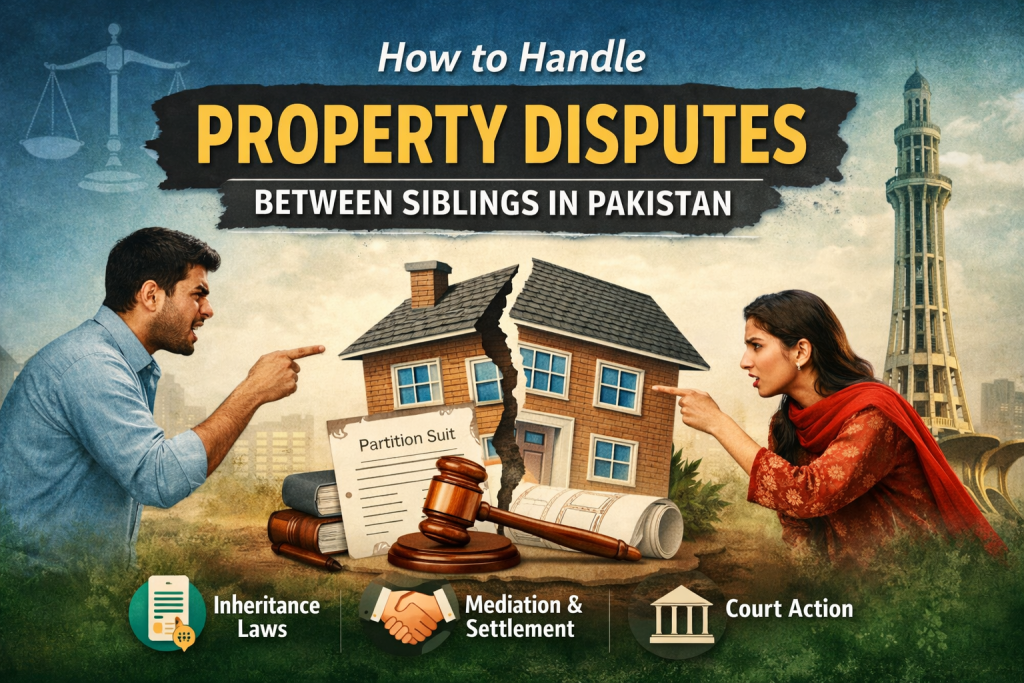
Property conflicts between siblings are one of the most emotionally and financially sensitive legal issues in Pakistan. When inheritance, varying contributions, or unclear ownership come into play, knowing How to Handle Property Disputes Between Siblings in Pakistan becomes critical to protect your rights and avoid protracted litigation. This guide offers practical, legally grounded solutions for real families facing these problems.
Table of Contents
Key Takeaways
- Understand common causes and legal risks in sibling property disputes.
- Step‑by‑step solutions from negotiation to court remedies.
- How to use official portals like e‑Registration for title verification.
- Regional and overseas Pakistani considerations.
Detailed Problem Analysis
Property disputes among siblings often arise from unclear expectations, lack of documentation, or disagreements after a death or sale. These disputes can involve inheritance law Pakistan, misunderstandings about land rights, or unequal financial contributions. In practice, a sibling might claim greater ownership due to paying more towards construction, while others argue inheritance rights under Islamic law or statutory succession. Without clarity, such disputes escalate into formal property partition suits which take years to resolve.
Some typical mistakes include:
- Relying solely on verbal agreements.
- Not verifying land ownership through revenue records.
- Ignoring formal conflict resolution before litigation.
These issues can be compounded by procedural errors like missing mutation entries or failure to register agreements legally, making disputes harder to resolve.
For deeper context, read about related issues in land record verification and practical steps to check ownership online.(Pakistan Era)
Step-by-Step Solutions / Guide
Resolving these disputes requires a structured, legally sound approach. This section provides actionable steps from early communication to formal litigation, including references to official portals.
Practical Steps to Resolution
- Document Collection & Verification
- Gather title deed, Fard‑e‑Malkiat, mutations.
- Use official portals like e‑Registration to verify deeds online, reducing risk of forgeries.(e-registration.gos.pk)
- Family Negotiation & Settlement
- Convene a family meeting.
- Discuss options like buyout, shared ownership, or property division.
- Mediation / Professional Facilitation
- Engage a neutral mediator to draft a written settlement agreement.
- Register the written agreement at a Sub‑Registrar Office to give it legal weight.
- Filing a Property Partition Suit
- If settlement fails, file a suit under Civil Procedure rules for partition and separate possession in the relevant District Court.(Pakarbiter)
- Court Commissioner & Decree
- The court may appoint a commissioner to assess division or recommend sale.
- Execution of Decree
- After the decree, implement the division or sale as ordered.
Preventive Legal Tips
- Always document family agreements in registered form.
- Verify land records online and at local land revenue offices before agreements.
Documents, Authorities & Fees Table
| Requirement | Authority / Office | Notes / Typical Fee |
|---|---|---|
| Title Verification | Sub‑Registrar / Land Revenue Office | Small verification charges |
| Family Settlement Registration | Sub‑Registrar Office | Standard registration + duty |
| Partition Suit Filing | Civil Court | Court fee based on property value |
| Mediation / Arbitration | Professional mediator | Agreed fee between parties |
Official External Links
- e‑Registration (Sindh) Portal – Official deed registration system.(e-registration.gos.pk)
- Punjab e‑Registration Portal – Deed registration and land record access in Punjab.(Punjab Land Records Authority)
Legal & Statutory Framework
Property disputes between siblings in Pakistan are governed by a combination of inheritance and civil laws. These provide the legal foundation for ownership, succession, and property division:
- Succession Act, 1925 (Official Law Text) – Governs intestate and testamentary succession, determining who inherits property after death.(revenue.kp.gov.pk)
- Partition Act, 1893 – Legal basis for court‑ordered partition of property.(Punjab Laws)
- Code of Civil Procedure (CPC), 1908 – Procedural rules for filing and adjudicating partition suits.(Scribd)
Plain Language Explanation:
- The Succession Act defines how property devolves on heirs when someone dies without a will.
- The Partition Act allows co‑owners to seek division of property.
- The CPC sets procedural steps for the court to manage and decide partition cases.
Regional or Situational Variations
Property dispute resolution can differ based on locality or family situation.
Provincial Differences
- Punjab & Sindh: Land records and e‑Registration systems facilitate online title verification and deed registration.(e-registration.gos.pk)
- KP & Balochistan: Check local revenue systems for provincial procedures.
Overseas Pakistani Considerations
Overseas Pakistanis should:
- Execute registered PoA for local representation in Pakistan.
- Ensure PoA is attested by Pakistani consulates/embassies.
Digital & Online Solutions / Tools
Digital platforms help verify property records and reduce disputes:
Official Verification Tools
- Sindh e‑Registration Portal – For accessing registered deeds and initiating registration.(e-registration.gos.pk)
- Punjab e‑Registration Portal (PLRA) – Online process to register and verify property deeds.(Punjab Land Records Authority)
- Revenue Department e‑Services – Some provinces offer land record search and fard applications online.(Pakistan Era)
Common Challenges & How to Overcome Them
Sibling disputes often stall due to emotional tensions, poor documentation, or ignorance about legal tools. Common mistakes include relying on oral agreements, delayed legal action, and overlooking digital record verification. The best practical solutions are early documentation, proactive verification, and professional legal consultation to save time and conflict.
FAQs
This section answers common questions about How to Handle Property Disputes Between Siblings in Pakistan with concise, actionable guidance.
- Can siblings resolve property disputes without court?
Yes — through negotiated, written agreements and mediation, registered with authorities. - What if a sibling lives abroad?
Overseas siblings can participate through a registered Power of Attorney. - Is a verbal agreement binding in property disputes?
No — only registered written agreements carry legal weight. - What court handles property partition suits?
Civil Courts (District Courts) where the property is located. - Can property be sold instead of partitioned?
Yes — with consent of all co‑owners or by court order. - What online tools help in dispute resolution?
Provincial e‑Registration portals help verify deeds and records before legal steps.(e-registration.gos.pk)
Conclusion
Dealing with sibling property disputes requires a blend of clear communication, verified documentation, and strategic legal steps. Early negotiation, use of official digital tools, and professional legal support significantly improve outcomes and reduce conflict costs.
Next Step: Consult a qualified property dispute lawyer in Pakistan to review your documents, explore settlement options, and guide you through court procedures if needed.
Contact
📞 Call/WhatsApp: +92‑333‑4241182
🌐 www.pakistanlegalservices.com
Comments
Have you faced property issues while living abroad?
Share your experience or questions below—your input may help others protect their property.
Disclaimer
This article is for informational purposes only. It does not constitute legal advice. For personalized assistance, consult a qualified lawyer in Pakistan.
About Author
Zaman Khan Vardag, Advocate of the Supreme Court of Pakistan and founder of Pakistan Legal Services, provides expert guidance in civil, criminal, family, and property law, including legal documentation, with a focus on overseas Pakistanis and foreign nationals.