
1. Introduction
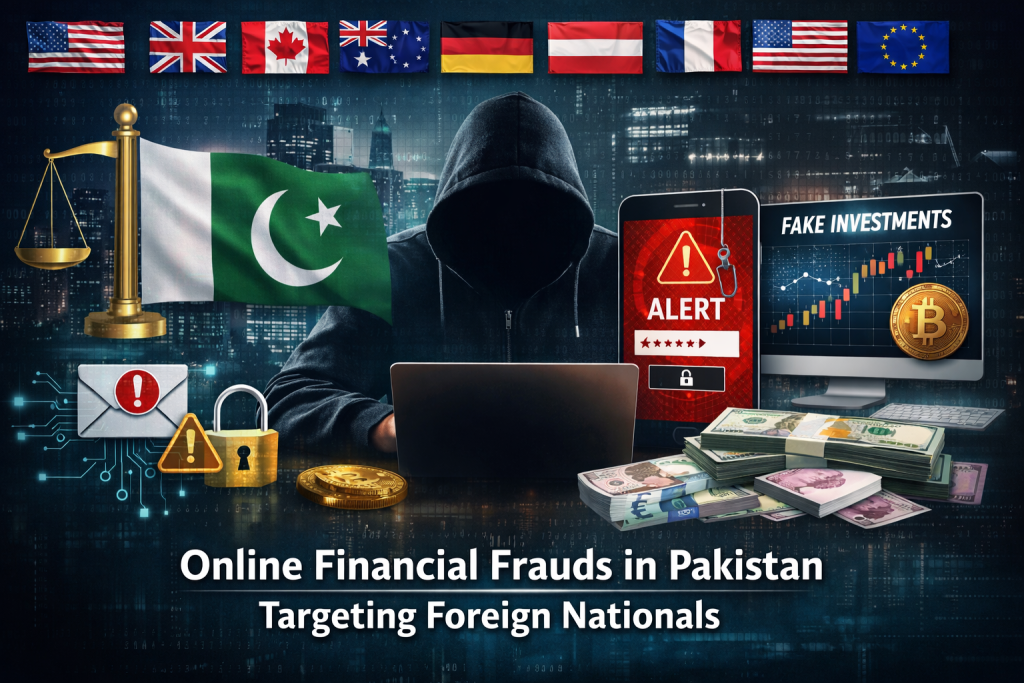
Online financial frauds in Pakistan targeting foreign nationals are increasingly sophisticated, posing serious risks to investors, digital users, and overseas professionals. As digital banking, online investments, and cross-border e-commerce continue to expand, fraudsters have evolved new strategies to exploit unsuspecting victims. These include fake investment platforms, phishing schemes, illegal call centers, romance scams, and advanced social engineering tactics.
Table of Contents
Foreign nationals face heightened vulnerability due to unfamiliarity with Pakistani legal procedures and jurisdictional complexities. Funds are often routed through multiple accounts, digital wallets, and cryptocurrencies, making recovery a challenging process. Understanding these frauds, their operation, and the legal remedies available is crucial for timely action and protecting assets.
2. Understanding Online Financial Frauds Targeting Foreign Nationals
Online financial frauds targeting foreign nationals occur when individuals or organized networks exploit digital platforms to illegally obtain money, banking credentials, or sensitive personal information. These scams often involve cross-border operations, where the perpetrator is located in Pakistan while the victim resides abroad, or vice versa.
Fraudsters use technologies like VPNs, VOIP numbers, and cloned websites to mask their location and identity. Foreign nationals are considered prime targets due to:
- Perceived Legal Gaps: Fraudsters assume foreign victims are unfamiliar with Pakistan’s complaint mechanisms and legal processes.
- High Financial Capacity: Many victims are professionals, investors, or high-net-worth individuals abroad.
- Exploitation of Digital Trust: Scammers create believable narratives, fake endorsements, or documents mimicking official institutions to gain trust.
Recognizing these frauds helps foreign nationals identify red flags, document evidence properly, and pursue legal remedies in Pakistan. Appointing legal representatives through an apostilled Special Power of Attorney (SPA) empowers attorneys to file complaints with agencies such as the National Cyber Crime Investigation Agency (NCCIA) while coordinating with authorities abroad.
3. Why Foreign Nationals Are a Primary Target
Fraudsters specifically target foreign nationals due to a combination of legal, technological, and psychological factors:
- Jurisdictional Complexity: Cross-border fraud creates legal challenges, as victims may be unaware of Pakistan’s laws or investigative agencies.
- High Financial Capacity: Investors and professionals are seen as lucrative targets for fake investment, cryptocurrency, and trading schemes.
- Limited Awareness of Local Enforcement: Many are unaware that Pakistan has robust cybercrime enforcement mechanisms, including NCCIA and the Prevention of Electronic Crimes Act (PECA) 2016.
- Trust Exploitation through Social Engineering: Scammers impersonate legitimate institutions, banks, or even family members to gain trust.
- Technological Advantage for Perpetrators: Using VPNs, spoofed international numbers, and encrypted communication channels, fraudsters hide their location and complicate tracing efforts.
Understanding these vulnerabilities emphasizes the importance of legal representation, evidence preservation, and filing both local and parallel complaints to strengthen the investigation.
4. Common Types of Online Financial Frauds
Foreign nationals may encounter a variety of online frauds originating from Pakistan. Awareness is crucial for early detection and legal action.
4.1 Fake Investment & Trading Platforms
Fraudsters create professional-looking online investment portals, promoting high returns in cryptocurrency, forex, or stock trading. They lure foreign victims with fake testimonials, fabricated performance charts, and realistic dashboards. Once victims invest, scammers block access or gradually siphon funds through multiple accounts, making recovery extremely difficult.
Example: In a recent case, victims from Europe lost thousands to a cryptocurrency investment scam operated from Karachi. Arrests were made after NCCIA traced the transactions.
4.2 Job & Work-from-Home Scams
Foreign nationals seeking remote employment are targeted with fake job offers demanding upfront payments for training, registration, or visa processing. Scammers may collect personal documents and banking details to commit identity theft or further financial fraud.
Tip: Verify employment opportunities and avoid sending money or sensitive information to unknown sources.
4.3 Phishing & Account Takeover
Scammers impersonate banks, online wallets, or financial institutions via emails, phone calls, or SMS. Victims are tricked into revealing login credentials, OTPs, or card details, allowing unauthorized access to accounts.
Preventive measure: Never share OTPs or passwords over email or phone.
4.4 Romance & Social Engineering Scams
Scammers build trust over weeks or months via social media, dating apps, or professional networking platforms. They exploit the emotional connection to request money, gifts, or digital transfers under false pretenses.
4.5 Lottery, Inheritance, & Visa Fee Scams
Foreign nationals receive notifications claiming lottery winnings, inheritance, or visa eligibility. Scammers request advance fees for taxes or administrative charges, often via foreign accounts or cryptocurrency.
Each fraud involves complex cross-border operations, making documentation and legal representation through an SPA critical.
5. Modus Operandi of Cross-Border Frauds
Common tactics include:
- Fake Websites & Apps: Mimicking legitimate banks or platforms with realistic dashboards.
- Social Engineering: Emails, calls, or messages exploiting trust.
- Identity & Location Masking: VPNs, VOIP, and foreign SIM cards.
- Layering of Funds: Routing through multiple bank accounts or digital wallets.
- Illegal Call Centers: Organized teams using scripts and impersonation.
- Parallel Operations: Collaborating with overseas accomplices for fund transfers.
6. Real-World Cases Involving Foreign Nationals
High-profile cases demonstrate the scale of such frauds:
6.1 Investment Scam Networks
In 2025, NCCIA uncovered fake cryptocurrency and forex platforms targeting victims across Europe, North America, and Asia. Arrests included local and foreign perpetrators, with accounts holding millions frozen.
6.2 Illegal Call Center Raids
Raids revealed call centers in Pakistan operating job, romance, and phishing scams targeting the US, UK, and Canada. Victims lost thousands before authorities intervened.
6.3 Phone & Banking Scams
Cybercrime rings in Islamabad tricked victims into sharing banking credentials. Investigations involved tracking digital evidence and freezing accounts.
Legal Coordination: SPA-based legal representatives filed complaints with NCCIA while victims also lodged parallel complaints abroad.
7. Legal Framework Governing Online Financial Frauds
7.1 Prevention of Electronic Crimes Act (PECA) 2016
PECA 2016 criminalizes unauthorized access, online fraud, phishing, and identity theft. Key sections relevant to financial fraud include:
- Section 3: Unauthorized access
- Section 7: Cyber terrorism
- Section 21: Fraud via electronic means
7.2 Anti-Money Laundering & Banking Regulations
AMLA addresses laundering of proceeds from online financial fraud. Banks must report suspicious transactions to assist in fund tracing.
7.3 International Cooperation
Mutual Legal Assistance Treaties (MLATs) and Interpol notices enable cross-border evidence sharing, asset tracing, and prosecution.
8. Role of Enforcement Agencies
Foreign victims rely on specialized agencies:
- NCCIA: Investigates cross-border cybercrime, receives complaints, traces transactions.
- FIA: Handles organized crime, raids illegal operations, collaborates with foreign authorities.
9. Legal Rights of Foreign Nationals
Victims have rights to:
- File complaints via SPA
- Appoint legal representation
- File parallel complaints abroad
- Protect privacy under PECA
- Receive investigation updates
10. Appointment of Legal Representatives
SPA empowers attorneys to:
- File complaints
- Submit evidence
- Represent victims in court
- Coordinate with authorities abroad
11. Filing Complaints in Pakistan
Steps:
- Prepare evidence: transaction records, communications.
- Execute SPA apostilled in the home country.
- File complaints with NCCIA/FIA, including SPA and evidence.
- Monitor investigation and attend hearings via legal representatives.
- Lodge parallel complaints abroad for cross-border coordination.
12. Challenges in Cross-Border Cases
- Jurisdictional disputes
- Evidence collection delays
- Extradition challenges
- Fund tracing complexities
- Communication and procedural delays
13. Impact on Victims & Pakistan’s Digital Reputation
Victims: Financial loss, stress, resource drain
Pakistan: Erosion of trust in digital platforms, potential decline in foreign investment
Mitigation: Awareness campaigns, SPA representation, timely complaint filing
14. Preventive Measures for Foreign Nationals
- Verify platforms and offers
- Maintain secure digital practices
- Recognize red flags
- Appoint SPA-based legal representation early
- File parallel complaints
- Preserve all evidence
15. Frequently Asked Questions (FAQs)
- Filing complaints: SPA-based filing possible
- SPA validity: Recognized, sometimes MOFA verification required
- Fund recovery: Possible with coordinated investigation
- Prosecution: Laws apply regardless of nationality
- Duration: Varies; parallel complaints help expedite
Conclusion
Online financial frauds in Pakistan targeting foreign nationals exploit cross-border digital channels, jurisdictional gaps, and sophisticated scams. SPA-based representation, complaints with NCCIA/FIA, and parallel complaints abroad maximize recovery and strengthen investigations. Proactive measures and timely legal intervention protect victims and uphold Pakistan’s international digital reputation.
You may also be intrested to read:Cyber Financial Frauds in Pakistan
Contact
Pakistan Legal Services
📞 +92‑333‑4241182
🌐 www.pakistanlegalservices.com
Disclaimer
⚠️ This article is for informational purposes only. It does not constitute legal advice. Consult a qualified lawyer for personalized guidance.