Even A Deal with the Establishment Is Not a Confession of Guilt
A new political narrative is being built around Imran Khan: he once declared that he would not compromise with the establishment, but now that the Supreme Court has ordered improved medical treatment, hospitalisation and greater access to his family, perhaps a deal has been struck. His political opponents are using this possibility to argue that Imran Khan has finally become “just like the others”—another politician who talks about principles in public but negotiates with the establishment when his own interests are at stake.
Table of Contents
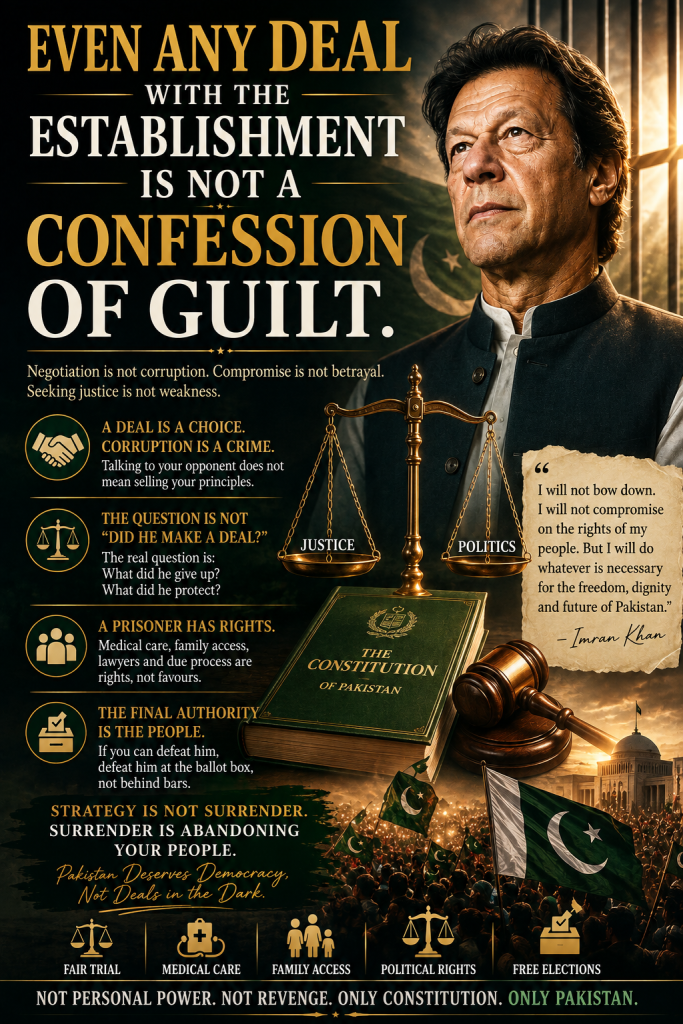
This argument may be politically convenient, but it is logically flawed. Even if Imran Khan has entered into negotiations with the establishment, negotiation by itself is not proof of corruption, hypocrisy or surrender. A political agreement is not a confession of guilt. It is not even necessarily an admission of weakness. To determine what a political settlement means, one must examine its terms, its purpose, what was exchanged and what was preserved.
That distinction is particularly important in Pakistan, where the relationship between elected governments and the country’s powerful military establishment has been a recurring feature of political life. Pakistan has experienced direct military rule as well as periods in which the military has been accused by analysts and political actors of exercising substantial influence over civilian politics.
The Word “Deal” Is Being Used as a Political Weapon
The most striking feature of the present debate is that the word “deal” is being treated as though it were itself evidence of wrongdoing.
It is not.
Suppose a prisoner negotiates for better medical treatment. Suppose he seeks access to his lawyers and family. Suppose he wants to regain his political rights. Suppose he wants an opportunity to return to the electorate and allow the people to decide his political future. None of these objectives is inherently corrupt. On the contrary, they are connected with basic legal rights and the functioning of constitutional democracy.
The same principle applies to a political leader negotiating with a powerful opponent. The existence of negotiations tells us that the parties are talking. It does not tell us what they have agreed upon.
If there is an actual agreement, the relevant questions are: What are its terms? What has Imran Khan given up? What has he obtained? Has he surrendered any constitutional principle? Has he abandoned the political mandate of his supporters? Has he accepted an unlawful personal benefit?
Without answers to these questions, declaring him “corrupt because he made a deal” is not an argument. It is a presumption.
Negotiation and Corruption Are Two Completely Different Things
The political attack on Imran Khan depends upon deliberately blurring three different concepts: negotiation, compromise and corruption.
Negotiation is the process of dealing with an opponent to achieve an objective. Compromise means accepting something less than one’s ideal position to obtain something considered more important. Corruption, by contrast, involves unlawful or improper personal benefit, abuse of public office, dishonesty or other wrongdoing. These concepts cannot simply be placed in the same category. A politician who negotiates for the restoration of constitutional rights is not necessarily corrupt. A prisoner who negotiates for proper medical treatment is not corrupt. An opposition leader who negotiates for free political activity is not corrupt.
Corruption would arise from what the person unlawfully receives or what improper thing he does in return, not merely from the fact that discussions took place. This is why the slogan “Imran Khan made a deal” is insufficient. The public needs to know what the alleged deal actually contains before making a moral judgment.
What If Imran Khan Really Has Negotiated?
Let us accept the allegation at its strongest. Suppose Imran Khan really has opened negotiations with the establishment. Would that prove that he has become like the politicians he criticised? No. It would prove only that he has decided that negotiation may be a useful political instrument under the circumstances confronting him. There is nothing inherently dishonourable in that.
A political leader may fight for years against an opponent and still eventually negotiate with that opponent. Indeed, negotiation often becomes necessary precisely because confrontation has reached a point where neither side can achieve its objectives without some form of accommodation. The moral character of the negotiation depends upon the objective and the price.
If a leader exchanges the national interest for personal wealth, office or immunity, that deserves condemnation. But if he negotiates to secure his freedom, protect his health, restore his political rights, bring an end to political victimisation and return the ultimate decision to the people, it is entirely reasonable to regard the negotiation as a political strategy rather than a surrender.
Imran Khan’s Circumstances Matter
Those criticising the possibility of negotiations often speak as though Imran Khan were negotiating from the comfort of a Prime Minister’s office. He is not. He has been imprisoned since 2023 and has faced more than 100 legal cases since his removal from office, according to Reuters. He denies the allegations and says that the cases are politically motivated. The circumstances surrounding his detention have also attracted international scrutiny. The UN Working Group on Arbitrary Detention previously concluded that his detention was arbitrary and raised concerns relating to fundamental rights and fair-trial standards.
Whatever one’s political opinion of Imran Khan, those circumstances cannot simply be ignored when judging whether negotiation is morally permissible.A man outside prison may have the luxury of saying, “I will never negotiate.” A man who has spent years in prison, facing continuing litigation and restrictions on his political activity, may reasonably calculate that obtaining his freedom and returning to constitutional politics is more important than preserving an absolute political slogan. That is not necessarily hypocrisy. It may be political realism.
A Prisoner Does Not Have to Remain in Prison to Prove His Principles
There is a dangerous romanticism surrounding political imprisonment: the idea that the longer a political leader remains in jail, the more principled he must be. That is not a sound constitutional principle. The purpose of political struggle should ultimately be to restore political freedom—not to remain permanently imprisoned as proof of one’s courage.
- If Imran Khan can lawfully secure his release, why should anyone demand that he remain in prison merely to prove that he never compromises?
- If he can obtain proper medical treatment, why should he refuse it?
- If he can meet his family, why should he reject that opportunity?
- If he can meet his lawyers and participate effectively in his defence, why should he consider that weakness?
- If he can return to political activity and ultimately face the people in an election, why should that be regarded as betrayal?
The purpose of political resistance is not suffering for its own sake. The purpose is to achieve the political objective.
The Supreme Court’s Medical Order Does Not Prove a Political Bargain
This distinction becomes particularly important following the Supreme Court’s recent order concerning Imran Khan’s medical treatment. On 18 August 2026, the Supreme Court ordered that Imran Khan be transferred from Adiala Jail to Shifa International Hospital for medical assessment and treatment. The order also addressed arrangements for family contact. The government has indicated that it intends to challenge or seek modification of the order. Immediately, however, some political voices interpreted the relief as evidence of a secret settlement. But this is precisely where political commentary must not replace evidence.
A Supreme Court order is a judicial act. It may be challenged, reviewed or criticised through lawful means. But a judicial order granting relief to a prisoner cannot itself be transformed into evidence that the prisoner has entered into a secret political bargain. If someone possesses evidence of such a bargain, let that evidence be produced. Otherwise, the allegation remains an allegation.
The Strongest Test Is Not “Did He Negotiate?” but “What Did He Negotiate Away?”
This is the central test that should be applied to Imran Khan.
- If he negotiated away the democratic mandate of his supporters merely to obtain personal power, that would be a serious betrayal.
- If he abandoned constitutional principles in exchange for personal immunity, that would deserve criticism.
- If he secretly accepted financial or political benefits for himself while sacrificing the public interest, the public would have every right to condemn him.
But suppose the opposite happened. Suppose he negotiated for his freedom while insisting upon fair trials. Suppose he sought restoration of political activity. Suppose he sought the right of his party to participate freely in elections. Suppose he demanded that political disputes ultimately be decided by the electorate. Would that make him corrupt? Obviously not. The crucial question is therefore not whether Imran Khan negotiates. The crucial question is what he negotiates away.
“He Became Just Like Them” Is the Real Political Narrative
Why, then, is so much emphasis being placed on the word “deal”? Because it attacks the foundation of Imran Khan’s political appeal. His political narrative has been built, in large part, around opposition to what he describes as a political system in which traditional parties and powerful institutions repeatedly make arrangements behind the scenes. If his opponents can persuade the public that Imran Khan has now entered the same arrangement, they can neutralise his strongest political distinction.
The message becomes: “You believed Imran Khan was different. He is not different. He has become exactly like the politicians he criticised.” That is a powerful political message. But it should not be accepted without evidence. The answer is not to declare Imran Khan perfect. The answer is to demand proof. Show the agreement. Show the terms. Show the benefit. Show the concession. Show the betrayal. Then the public can decide.
A Political Leader Can Change Strategy Without Changing His Principles
There is another important distinction that is frequently ignored. Principles and strategies are not the same thing. A principle may remain constant while the strategy for achieving it changes. A politician may believe that civilian supremacy is desirable but nevertheless negotiate with the institution that currently possesses greater political power. A politician may believe in free elections but negotiate with opponents to create conditions in which elections can actually take place. A politician may oppose political victimisation but still negotiate to end his own imprisonment.
There is no contradiction unless the negotiation requires him to abandon the principle itself. This is why the statement, “He once said he would never negotiate, therefore any negotiation is betrayal,” is too simplistic. Political statements made during one set of circumstances cannot sensibly be converted into permanent legal or moral contracts preventing a leader from responding to entirely different circumstances.
What Would Actually Constitute Betrayal?
If the critics of Imran Khan genuinely believe that a deal would constitute betrayal, they should define what they mean.
- Would it be betrayal if he obtained medical treatment?
- Would it be betrayal if he obtained access to his family?
- Would it be betrayal if he obtained access to his lawyers?
- Would it be betrayal if he secured release from prison through lawful proceedings?
- Would it be betrayal if his party were allowed to participate freely in elections?
- Would it be betrayal if he agreed to settle political disputes peacefully?
None of these things is inherently a betrayal of democracy. The line would be crossed if he exchanged the public interest for a private advantage or accepted the permanent exclusion of the people’s mandate merely to secure his own personal comfort. That is the standard that should be applied. And there is currently no public evidence establishing that such a bargain has occurred.
The Public Should Not Be Asked to Choose Between “Deal” and “No Deal”
There is an even deeper problem with the current debate. It assumes that if Imran Khan negotiates, he must have surrendered; and if he refuses to negotiate, he must remain imprisoned. That is a false choice. A mature political strategy can include both resistance and negotiation. A leader can reject unlawful demands while negotiating lawful ones. He can oppose institutional interference while talking to institutional actors. He can maintain his political position while seeking a peaceful route out of a political deadlock.
Indeed, refusing every form of communication with an adversary can sometimes be less principled than negotiating a peaceful solution. The real measure of leadership is not how loudly one refuses to negotiate. It is whether one knows what must never be surrendered and what may legitimately be negotiated.
If a Deal Restores Constitutional Politics, Should the Public Oppose It?
This is the question that Imran Khan’s critics should answer. Suppose a political settlement resulted in an end to political victimisation, fair trials, restoration of political rights and a genuinely competitive election. Would Pakistan be worse because Imran Khan negotiated those conditions? Or would Pakistan be better because political conflict had finally returned to the ballot box? If the ultimate objective is constitutional democracy, then the route by which political actors reach that objective matters—but it does not follow that every negotiation is illegitimate. The people of Pakistan should not demand that their politicians remain prisoners simply to preserve the purity of political rhetoric. They should demand something much more important: Give us our vote. Give us fair elections. Give us independent courts. Give every political leader due process. Then let the people decide.
The Final Test: The People, Not the Establishment, Must Decide
Ultimately, the debate over a possible Imran Khan deal should lead to a much bigger question. Why should Pakistan’s political future depend upon whether Imran Khan has reached an understanding with the establishment? Why should any politician need the approval of an unelected power centre to exercise political rights? Why should political victory be achieved through imprisonment or exclusion when it can be achieved through the ballot box?
- If Imran Khan has become unpopular, let his opponents defeat him in an election.
- If he remains popular, let him contest and let the people decide.
- If he is guilty, give him a fair trial and establish his guilt according to law.
- If he is entitled to medical treatment, provide it.
- If he is entitled to meet his family and lawyers, respect those rights.
And if he chooses to negotiate with his opponents in order to regain his freedom and return to democratic politics, do not automatically call that corruption. Even A deal is not a confession of guilt. Negotiation is not surrender. Political compromise is not necessarily corruption.
The only question that truly matters is:
What did Imran Khan give up—and what did he preserve?
If he sacrificed the public interest for personal power, history and the people should judge him. But if he negotiated in order to preserve his political movement, protect his fundamental rights, return to democratic politics and ultimately place his fate once again in the hands of the Pakistani electorate, then calling that “betrayal” would be nothing more than a political slogan. And Pakistan has had enough of political slogans.
The country now needs evidence, constitutionalism and the right of the people to decide who governs them.