
✅ Introduction
Overseas Pakistanis frequently ask:
Table of Contents
👉 “Do I need to become a tax filer in Pakistan before buying property?”
The answer is not always.
Under Pakistani tax law, non-resident overseas Pakistanis can purchase property by availing a transaction-based exemption / filer-rate facility—without becoming a regular filer—subject to strict legal conditions.
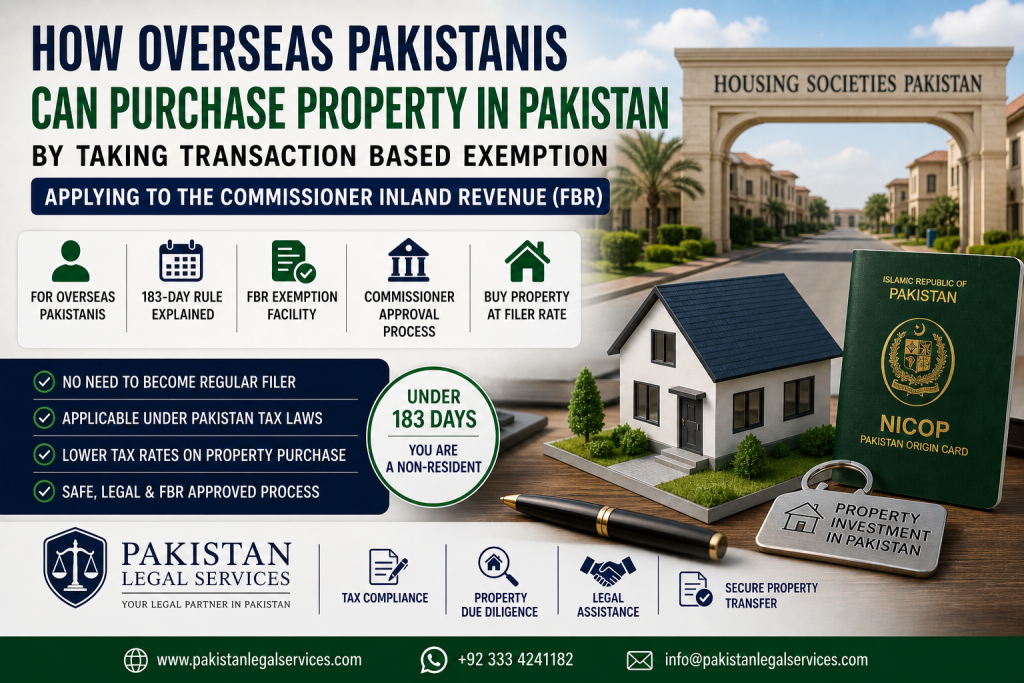
This guide explains How Overseas Pakistanis to Buy Property Without Becoming Filer in Pakistan by applying for exemtion to the Federal Board of Revenue FBR through the Commissioner Inland Revenue.
⚖️ 1. Legal Framework (What Law Actually Says)
The governing law is the:
👉 Income Tax Ordinance, 2001
Relevant provisions:
- Section 236K → Tax on purchase of property
- Section 236C → Tax on sale of property
- Clause 111AC (Finance Act 2022) → Relief for overseas Pakistanis
👉 These laws allow overseas Pakistanis to pay filer tax rates even if they are not filers, subject to conditions. (FBR)
🌍 2. Who Qualifies? (Eligibility Criteria)
To use this facility, the person must:
✔ Hold Overseas Identity
- NICOP (National Identity Card for Overseas Pakistanis)
- OR POC (Pakistan Origin Card)
✔ Be a “Non-Resident”
This is where the 183-day rule applies:
👉 If a person stays in Pakistan for less than 183 days in a financial year, he is treated as a non-resident. (FBR)
👉 If stay exceeds 183 days → treated as resident → must file tax return
📊 3. Understanding the 183-Day Rule (Very Important)
What is it?
The 183-day rule determines your tax residency status.
✔ Non-Resident (Eligible for exemption)
- Stay in Pakistan: Less than 183 days
- Taxed only on Pakistan-source income
- Eligible for filer-rate facility without ATL
❌ Resident (No exemption)
- Stay in Pakistan: 183 days or more
- Must file income tax return
- Full compliance required
👉 This is the foundation of your entire tax strategy
🧾 4. What is “Transaction-Based Filer Exemption”?
This is NOT a permanent filer status.
👉 It is a one-time facilitation allowing:
- Payment of lower filer tax rates
- Without appearing in ATL
FBR allows this to encourage overseas investment. (Profit by Pakistan Today)
🏛️ 5. Step-by-Step Process (Commissioner Approval Route)
Step 1 — Register on FBR Portal
- Create account on IRIS
- Enter NICOP/POC details
Step 2 — Generate PSID
- Enter property details
- System generates Payment Slip ID (PSID)
Step 3 — Upload Documents
- NICOP/POC
- Passport
- Proof of overseas residence
- Declaration of non-resident status
Step 4 — Apply to Commissioner Inland Revenue
👉 The system forwards your case to Commissioner for approval
- Commissioner verifies non-resident status
- May request additional documents
Step 5 — Approval by FBR
Once approved:
✔ You become eligible for filer tax rate
✔ System activates PSID
👉 This approval is mandatory in most cases. (Profit by Pakistan Today)
Step 6 — Pay Advance Tax
Under Sections 236K / 236C:
- Pay tax via PSID
- At filer rate (much lower)
Step 7 — Complete Property Transfer
Now you can purchase property in
Bahria Town Lahore
💰 6. Why This Facility Matters (Tax Comparison)
| Status | Tax Rate Impact |
|---|---|
| Filer | Lowest |
| Late Filer | Medium |
| Non-Filer | Very High |
👉 Overseas exemption allows non-filer to pay filer rate
This can save millions of rupees in large transactions. (Profit by Pakistan Today)
⚠️ 7. Important Legal Warnings
❌ Myth: “No need to ever file tax return”
👉 Incorrect
- This is transaction-specific relief
- Not permanent exemption
❌ Risk Areas
- Wrong residency declaration
- Undocumented funds
- Future sale complications
- FBR audit / notice
✔ Safe Practice
Even if exemption is used:
👉 File NIL return later (recommended)
👉 Maintain record of funds
🏢 8. How Pakistan Legal Services Can Help
As a law firm, you should offer:
✔ FBR Compliance Service
- IRIS registration
- PSID generation
- Commissioner application
✔ Legal Due Diligence
- Property verification
- Document checking
- Fraud prevention
✔ Transaction Handling
- Agreement drafting
- Transfer execution
- Representation
🧠 9. Critical Analysis (Expert Insight)
This policy is designed to:
✔ Encourage overseas investment
✔ Simplify tax compliance
BUT:
❗ It is not a substitute for full tax compliance
❗ Misuse can lead to future legal exposure
👉 Best strategy:
“Use exemption for entry → build compliance for long-term safety”
🚀 10. Final Recommendation
If you are an overseas Pakistani:
👉 You have TWO options:
Option 1 (Safe)
Become regular filer
Option 2 (Flexible)
Use Commissioner approval + filer-rate facility
👉 Our Professional Advice:
Use the exemption for purchase, but regularize your tax profile afterwards
📞 Contact Pakistan Legal Services
📱 Call/WhatsApp: +92-333-4241182
🌐 Website: www.pakistanlegalservices.com
📧 Email: info@pakistanlegalservices.com
⚖️ Disclaimer
Disclaimer: This article is for informational purposes only. It does not constitute legal advice. For personalized assistance, consult a qualified lawyer in Pakistan.
💬 Comments
Have questions about overseas property investment?
Drop your query below or contact us directly.
👨⚖️ About the Author
Zaman Khan Vardag is an Advocate and legal consultant at Pakistan Legal Services, specializing in property law, overseas legal matters, and tax compliance in Pakistan.

